Friday, 11 December 2009

Best iPhone plans for 8GB and 16GB

Features of 3 iPhone models

Yesterday, I have written the best plans for iPhone 3GS 32GB (3rd generation iPhone). This phone is the latest Apple phone with a faster processor, slightly superior battery life equipped with a 3.2MP camera compared to the 2nd generation iPhone 3G. The 16GB version has half the flash memory as compared to the 32GB version so it is cheaper in value. If you have few applications, songs and data to be stored on the iPhone, a 16GB is sufficed for your daily use. 32GB version is an overkill as flash memory is always dropped as the production reaches economic of scales powered by the increasing demand of flash memory in storage arena.

In contrast, iPhone 3G with a modest 8GB is the 2nd generation iPhone with 2MP camera but with 3G support, it works well with any of the minimum 12GB data plans. So is iPhone 3G 8GB having a slower download speed as compared to the latest 3GS iPhone 16GB or 32GB? The answer is no. The download speed for both iPhone 3G and 3GS are at a maximum speed of 7.2Mbps (HSDPA). Since all 3 telcos are matching with 7.2Mbps for all iPhone plans, the only speed bottlenecks lie in the network coverage and the environment where you are in. You may refer to the earlier blog on how to measure the data speed with your mobile phone. On the side note, you may wish to consider the upload speed which is not mentioned in the websites of all the 3 telcos. For example, Starhub offers a upload speed of 1.9Mbps for all its iPhone plans.

The premium plans will not be discussed because these 2 models belong to the lower end and premium plans do not change much. If you wish to get 3G 8GB or 3GS 16GB, you may wish to refer to the earlier blog. The differences are minor as the monthly subscriptions form the majority of the Total Cost of Ownership (TCO).

iPhone 3G 8GB

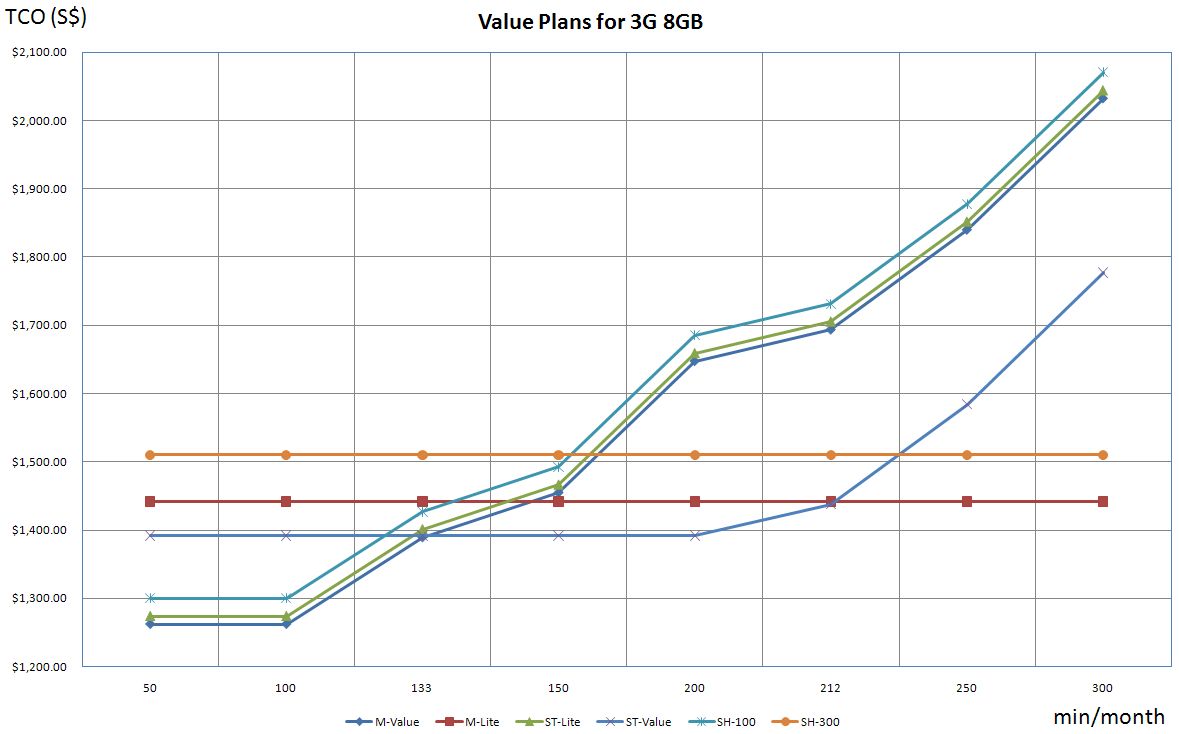
With no worry on its speed, the next concern is choosing the right plan. This model is ideal for value proposition since it has the lowest top-up value. The following table is derived.

Mins/month

M-Value

M-Lite

ST-Lite

ST-Value

SH-100

SH-300

50

$ 1,262.00

$ 1,442.00

$ 1,274.00

$ 1,391.76

$ 1,300.00

$ 1,510.00

100

$ 1,262.00

$ 1,442.00

$ 1,274.00

$ 1,391.76

$ 1,300.00

$ 1,510.00

134

$ 1,392.97

$ 1,442.00

$ 1,404.97

$ 1,391.76

$ 1,430.97

$ 1,510.00

150

$ 1,454.60

$ 1,442.00

$ 1,466.60

$ 1,391.76

$ 1,492.60

$ 1,510.00

200

$ 1,647.20

$ 1,442.00

$ 1,659.20

$ 1,391.76

$ 1,685.20

$ 1,510.00

212

$ 1,693.42

$ 1,442.00

$ 1,705.42

$ 1,437.98

$ 1,731.42

$ 1,510.00

250

$ 1,839.80

$ 1,442.00

$ 1,851.80

$ 1,584.36

$ 1,877.80

$ 1,510.00

300

$ 2,032.40

$ 1,442.00

$ 2,044.40

$ 1,776.96

$ 2,070.40

$ 1,510.00


From the graph, we observe that M1's plans beat Starhub's plans flat. If you are having an average call out of 134 to 212 minutes/month, it is wise to choose Singtel M-Value Plan. Else M1 M-Value and M-Lite plans provide the lowest TCO for the rest.

iPhone 3GS 16GB

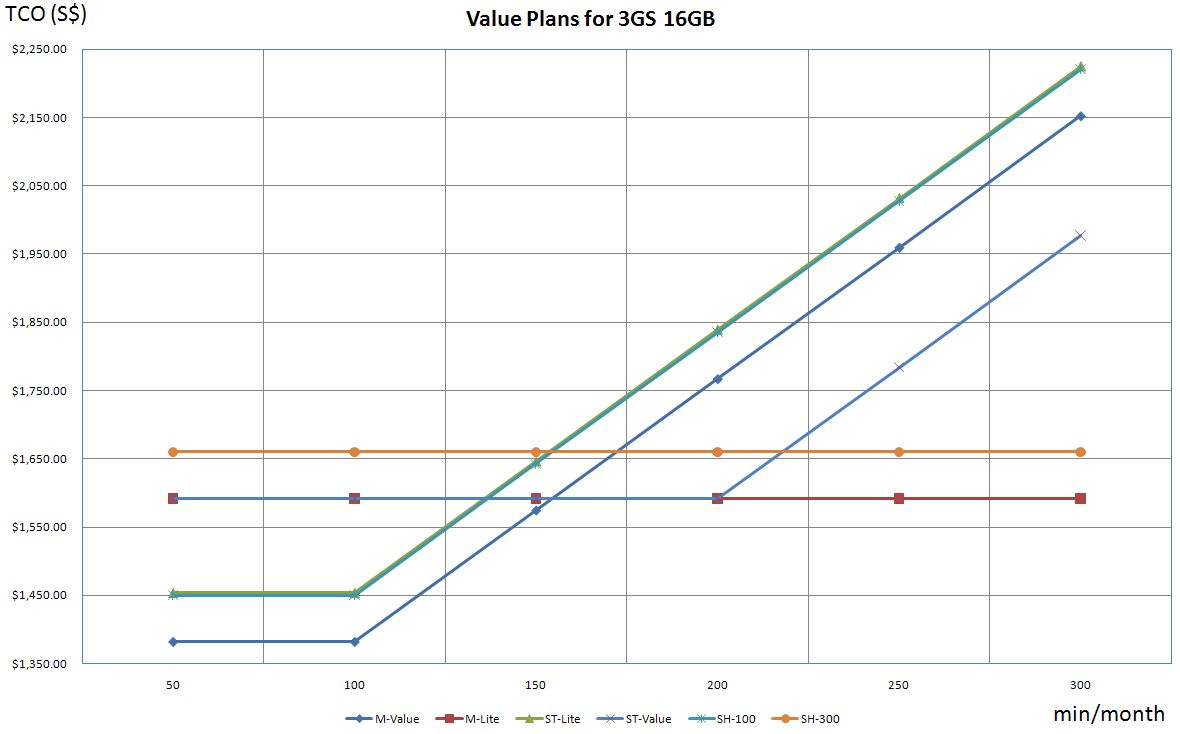
The plans for this mid end phone are presented below.

Mins/month

M-Value

M-Lite

ST-Lite

ST-Value

SH-100

SH-300

50

$ 1,382.00

$ 1,592.00

$ 1,454.00

$ 1,591.76

$ 1,450.00

$ 1,660.00

100

$ 1,382.00

$ 1,592.00

$ 1,454.00

$ 1,591.76

$ 1,450.00

$ 1,660.00

150

$ 1,574.60

$ 1,592.00

$ 1,646.60

$ 1,591.76

$ 1,642.60

$ 1,660.00

200

$ 1,767.20

$ 1,592.00

$ 1,839.20

$ 1,591.76

$ 1,835.20

$ 1,660.00

250

$ 1,959.80

$ 1,592.00

$ 2,031.80

$ 1,784.36

$ 2,027.80

$ 1,660.00

300

$ 2,152.40

$ 1,592.00

$ 2,224.40

$ 1,976.96

$ 2,220.40

$ 1,660.00


The graph depicts that both M1 plans are the clear winners in the value market except for 200mins/month, Singtel Value wins a marginal S$0.24. Now, you can tell any blind man to get M1 plan if he wants a iPhone 3G 16GB. However, Starhub SH-300 is a close competitor with M1 M-Lite with a small S$68 margin.

Conclusions

For easy reference, the TCO table for all phones and plans is shown below.

Mins/month

Lowest TCO

3G 8GB

Lowest TCO

3GS 16GB

Lowest TCO

3GS 32GB

50

$ 1,262.00

M-Value

$ 1,382.00

M-Value

$ 1,522.00

M-Value

100

$ 1,262.00

M-Value

$ 1,382.00

M-Value

$ 1,522.00

M-Value

150

$ 1,391.76

ST-Value

$ 1,574.60

M-Value

$ 1,714.60

M-Value

200

$ 1,391.76

ST-Value

$ 1,591.76

ST-Value

$ 1,741.76

ST-Value

250

$ 1,442.00

M-Lite

$ 1,592.00

M-Lite

$ 1,742.00

M-Lite

300

$ 1,442.00

M-Lite

$ 1,592.00

M-Lite

$ 1,742.00

M-Lite

450

$ 2,019.80

M-Lite

$ 2,169.80

M-Lite

$ 2,319.80

M-Lite

500

$ 2,212.40

M-Lite

$ 2,280.00

ST-Plus

$ 2,378.00

ST-Plus

700

$ 2,352.00

M-Extreme

$ 2,352.00

M-Extreme

$ 2,450.00

M-Extreme

1000

$ 3,507.60

M-Extreme

$ 3,507.60

M-Extreme

$ 3,605.60

M-Extreme

1500

$ 4,752.00

M-Unlimited

$ 4,752.00

M-Unlimited

$ 4,752.00

M-Unlimited


For the lowest TCO, your wallet will suffer a damage of S$1,262. This is the lowest price for owning a iPhone. You must refrain from abusing the data bandwidth and exceed the limit of monthly data usage for value plans.

By far, M1 plans win in nearly every category. Singtel has a few winners but Starhub has none. This clearly explains why M1 shops are crowded with human queues while Starhub shops are crowded with flies. As a smart consumer, be prepared to choose the best plan from the chart below before you join in the queue. Remember to consider M1's Take-3 plan, Free Calls to 3 M1 numbers, Unlimited SMS and MMS plus Free Campus/Army Camp calls (students and NSFs) and 35% discount on Multi-Line Saver to enjoy greater discounts.

TRUE WINNER

With the above, do you think you are the winner in this war? Unfortunately, the answer is NO. M1 laughs all the way to the bank if everyone signs up their M-value plan. Why?

From M1 perspective, they wish to regain market share as they do not complete package like Singtel's MIO and Starhub's Hubber as they do not own the infrastructure.

From consumer end, you are the "biggest" loser by choosing M-Value because it has the lowest value amongst the plans. If we only consider voice calls and SMSs, below are the perceived values of the plans based on simple calculations.


M-Value

M-Lite

M-Extreme

Explanation & Formula

Monthly Fee (w/GST)

$ 36.00

$ 56.00

$ 98.00

A

Free voice call (mins)

100.00

300.00

700.00

B=$0.1605/min

Free SMS/MMS

500.00

500.00

500.00

C=$0.05/SMS


Bundled value

$ 985.20

$ 1,755.60

$ 3,296.40

D=(free call x B)+(free SMS x C)

2 years contract

$ 864.00

$ 1,344.00

$ 2,352.00

E=24 mths x A

Cost of phone

$ 398.00

$ 98.00

$ -

F

Perceived Values (PV)

$ (276.80)

$ 313.60

$ 944.40

PV=D-E-F


So signing up the M-Extreme plan gives you a gain of S$944 as compared to M-Value plan of –$276.80. You may argue the costs of operation for calls and SMSs are much lower on the operator side. Yes, you are right and this precisely iterates the fact that you must stick to your plan and should not exceed the allocated time or data usage. So I hope these tables will assist you in selecting a good iPhone as well as a good plan to complement it.

Thursday, 10 December 2009

Select your best iPhone 3GS 32GB plan…

Telco war

Peace is disrupted yesterday when all 3 telcos are selling iPhone. OCWORKBENCH is the first in Singapore to report live on the iPhone war with a nice chart breaking down the various plans offered by the 3 telcos. If you follow their twitter, you can be updated on last minute surprises offered by M1 and Starhub to sweeten their offerings. Many Singaporeans are queuing up to get their iPhone because monkeys see, monkeys do (as they said in the army). If you are one of them, do you know what plan is suitable for yourself? Or you just sign the cheapest plan to get your dream iPhone?

Factors to consider

I have earlier blogged on some concerns before you upgrade your phone or plan. Perhaps it is good for you to read it before you run down to queue up. It is important that you are sure that you NEED a iPhone before you read further on the plans offered. Many claimed that marketing department in Apple is doing a great job in pushing you a product that you don't need. So don't jump on it if you only make voice calls and send SMSs. It is trendy to carry the latest model 3GS but you look stupid if you have no applications using the data plan. Yes, all iPhone plans come with minimum 12 GB of data plan which is great if you use GPS, MSN, Email, Surf web, Twitter, Internet radio, YouTube, Facebook and watch internet TV. 12GB is a lot of data and most users are unlikely to exceed this quota in a month. Thus, we will not be considering data transfer in our tabulation.

I would like to introduce a term known as the total cost of ownership (TCO) in our evaluation. TCO includes the monthly subscription (voice and data) you are paying and the cost of the phone. It is only fair to compare different plans as there is an amount to pay for the price of the phone for different plans. Below is an example of the Singtel iPhone plan for 3GS 32GB.

iPhone 3GS 32GB

Lite

Value

Plus

Premium

Monthly Fees (S$)

39.00

55.99

95.00

204.99

Extra cost for phone (S$)

658.00

398.00

98.00

0.00

TCO for 2 yrs contract (S$)

1,594.00

1,741.76

2,378.00

4,919.76

After you confirm iPhone is suitable for you, you should consider how many calls you make a month because this is one of the determining factor in various plans. If you are a light user, a 100 minute/month plan may be suitable for you. If you are a heavy user, you should consider the unlimited plan. It may be a good time to take out your mobile bills for the past year and calculate how many minutes you use per month. With this, let's begin to search the best plan for iPhone 3GS 32GB.

Value Plans (<300 minutes/month)

As the name suggests, this plan is suitable for consumer with a budget or makes only few calls. If you choose this plan and use more than 300 minutes, you will be paying a dear premium. So if you use 350 min/month, it is strong advised to select the next higher plan. Based on TCO on the plans offered by telco, the table is derived.

TCO

M-Value

M-Lite

ST-Lite

ST-Value

SH-100

SH-300

50

$ 1,522.00

$ 1,742.00

$ 1,594.00

$ 1,741.76

$ 1,580.00

$ 1,810.00

100

$ 1,522.00

$ 1,742.00

$ 1,594.00

$ 1,741.76

$ 1,580.00

$ 1,810.00

150

$ 1,714.60

$ 1,742.00

$ 1,786.60

$ 1,741.76

$ 1,772.60

$ 1,810.00

200

$ 1,907.20

$ 1,742.00

$ 1,979.20

$ 1,741.76

$ 1,965.20

$ 1,810.00

250

$ 2,099.80

$ 1,742.00

$ 2,171.80

$ 1,934.36

$ 2,157.80

$ 1,810.00

300

$ 2,292.40

$ 1,742.00

$ 2,364.40

$ 2,126.96

$ 2,350.40

$ 1,810.00


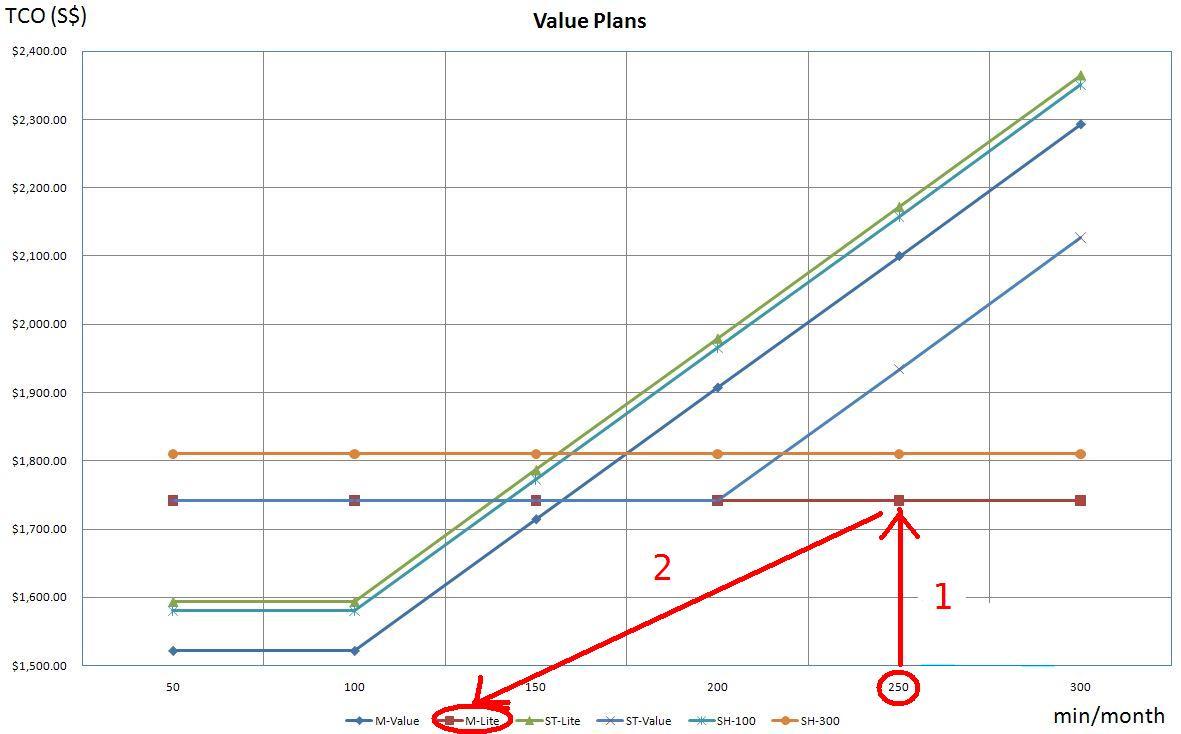
This above picture shows the TCO of the value plans. The lower the TCO, you pay lower. So with the min/mth value in the x-axis, move vertically up and the first line you touch is the best plan you should get.

From the graph, you should get M-Lite plan if you using an average of 250 minutes/month. Note that the TCO increases drastically if you exceed the voice minutes in your plan.

Premium Plans (>300 minutes/mth)

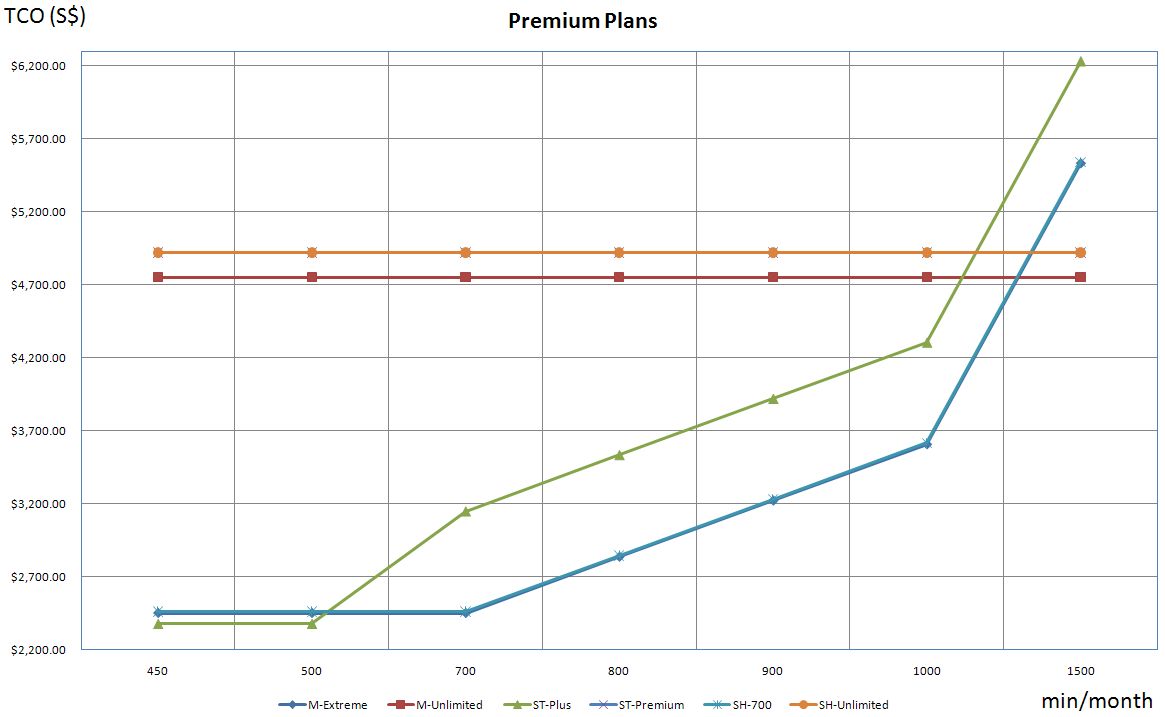
Next, we shall consider the premium plans which range from 450 to unlimited minutes/month. The following table is derived.


M-Extreme

M-Unlimited

ST-Plus

ST-Premium

SH-700

SH-Unlimited

450

$ 2,450.00

$ 4,752.00

$ 2,378.00

$ 4,919.76

$ 2,460.00

$ 4,920.00

500

$ 2,450.00

$ 4,752.00

$ 2,378.00

$ 4,919.76

$ 2,460.00

$ 4,920.00

700

$ 2,450.00

$ 4,752.00

$ 3,148.40

$ 4,919.76

$ 2,460.00

$ 4,920.00

800

$ 2,835.20

$ 4,752.00

$ 3,533.60

$ 4,919.76

$ 2,845.20

$ 4,920.00

900

$ 3,220.40

$ 4,752.00

$ 3,918.80

$ 4,919.76

$ 3,230.40

$ 4,920.00

1000

$ 3,605.60

$ 4,752.00

$ 4,304.00

$ 4,919.76

$ 3,615.60

$ 4,920.00

1500

$ 5,531.60

$ 4,752.00

$ 6,230.00

$ 4,919.76

$ 5,541.60

$ 4,920.00


With the graph, we can see the TCO for such plan has a minimum of S$2,378. So you should be signing for either M-Extreme or SH-700 if you are using 800 minutes/month.

Limitations

There are limitations in this method which should be factored in. Different telcos offer different candies to sweeten the products. M1 has Take-3 plan, Starhub has free TV channels while Singtel has other plans with MIO bundling. This analysis only consider iPhone 3GS 32GB and not 3G 8GB and 3GS 16GB.

Conclusions

To assist you in selecting the plan, the table below will help you in selecting your plan. You will also be able to know your damage in owning a iPhone 3GS 32GB.

mins/mth

Lowest TCO

Plan

50

$ 1,522.00

M-Value

100

$ 1,522.00

M-Value

150

$ 1,714.60

M-Value

200

$ 1,741.76

ST-Value

250

$ 1,742.00

M-Lite

300

$ 1,742.00

M-Lite

450

$ 2,319.80

M-Lite

500

$ 2,378.00

ST-Plus

700

$ 2,450.00

M-Extreme

800

$ 2,835.20

M-Extreme

900

$ 3,220.40

M-Extreme

1000

$ 3,605.60

M-Extreme

1500

$ 4,752.00

M-Unlimited

Looking forward, I predict that with iPhone setting the precedence, data plan will be more affordable to the masses and Singaporeans will be able to try and apply applications in their daily life. After all, Singapore is a small island and well connected wirelessly. We should be able to surf internet while on the move. Having said that, prices will only get lower so I see that there is no need to rush and get a iPhone. Spend some time in reading this blog and understand your needs is better than getting a white elephant which will eventually pass down to your children or your parents when you are sick of this "hi-tech" toy. If election deserves one cooling off day, so do you.

Wednesday, 18 November 2009

Should I buy CPF Life?


WHAT IS CPF LIFE?

Singapore is not a welfare state and the government has no obligation to take care of your retirement and golden years after your retirement. The abolishment of the pension scheme (inherited from the British Colonial days) and the introduction of the CPF scheme simply tell Singaporeans that they must not depend on government's mercy if you are old and poor. Around 15 years ago, a few insurance companies introduce annuities policies for the retirees and many benefitted from the scheme with monthly payout of a small amount of money till they die. Due to the lack of financial acumen, those who did not take up this offer suffered now as they see their savings dry up after 20 years in CPF retirement or fixed savings accounts. The recent years of low interest rate on fixed deposits at 1% due to the turmoil worsens their woes. Inflation of prices on daily necessities shrinks their pool of retirement funds.
CPF LIFE aims to bridge the gap and offers this retirement vehicle in view of the increasing pool of retirees plunging into financial difficulties. CPF LIFE is definitely better than the Minimum Sum Scheme (MSS) which only last 20 years. In fact, it is replacing MMS and applies to those who are born after 1957 and have at least S$40k in the retirement account (RA). However, it arrives 15 years (compared to the private sector) too late and those who are already in trouble will not enjoy as much as their money has depleted over the years in fixed deposits. Those who are below 55 years will definitely benefit from this scheme. 30,000 residents (reported by TODAY) flooded to CPF and rushed to place over S$1.26 billion to buy CPF LIFE. But is this a good scheme? Is it suitable for you? Why 670,000 Singaporeans/PRs are not responding to this 2-month old call?

POSSIBLE REASONS FOR DELAY

Since 15 years ago, private firms are soliciting annuities policies and 71,000 are in force as of 2Q 2009. This tells us only 90% of residents are not aware about these policies, fail to see any advantages offered by these policies or cannot afford them. Indeed, there are 2 barriers of entry for these policies - a minimum sum (tens of thousands) is required and there is a waiting time (5 years) to collect the first payout. After working for many years and retire at 55, they can finally touch and feel their retirement money in the CPF. It is unbearable to part their hard earned money and tell them to wait 5 more years. Many choose to spend on their children or go for tours to see the world.
CPF LIFE eliminates at least 1 barrier for many concerned. You can buy any amount of annuities and those who are born before 1947 can get the first payout in less than 5 years. So we see a reshuffle of cards in the field of annuities and I hope private sectors will introduce better schemes soon. More offers and products in markets are always good for consumers. The promotion of such policies also benefits all residents with CPF Board pumping in more money to introduce what is the concept of "annuity" to many residents.
However, some just cannot afford to buy these policies as they are the sole income earner in the family. Sadly, many can afford but are not financial savvy to buy them. After all, to these folks, money is a sensitive topic and this quiet generation believes in keeping their money in trustworthy banks as fixed deposits over unit trusts, shares or other investment instruments. They fail to realize that their money suffer from inflation and depreciation over time. Let me tell you why.

CONCEPT OF PERPETUITY

Perpetuity (aka perpetual annuity or infinite annuity) refers to annuity that pays forever. "Forever" is a strong concept because it implies no time limit. As long as you are alive, you will receive monthly income from CPF LIFE based on a one-time fixed amount you buy previously. The only challenge for you is to stay alive and outlive others. This promises continuous income over fixed deposits concept. An example will better illustrate the concept of perpetuity.
Upon retirement, you wish to place S$10k in a bank which promises 2.5% yearly fixed deposit interests (current fixed deposit interests is 0.9% for S$30k). You wish to withdraw S$1k (at the beginning of every year) from the fund as yearly expenses. Using simple financial formula, you will exhaust S$10k in 11.32 years. For perpetuity, the present value (PV) for S$1k yearly withdrawal at 2.5% interests is S$40k. This is 4 times more the amount in an ideal condition. This simply implies that if you put S$40k in a bank which promises yearly 2.5% interests, you can collect S$1k forever or until you die, whichever is shorter. So you must live longer than 11.32 years to benefit from the perpetuity scheme. Eventually, the question to ask is not which scheme benefits you more how to live healthier and longer.

THE CPF LIFE'S OFFER

In the offer, there are 4 plans to choose from. The majority chose to buy the LIFE PLUS PLAN while one-third signed up for the LIFE BALANCED PLAN. The differences lie in the payouts to beneficiaries and a compromise between waiting time and premiums. Each has its own merits. The other 2 extreme plans are the LIFE BASIC PLAN and LIFE INCOME PLAN which promises the lowest and highest monthly payout respectively. The former is unattractive to many while the latter targets unmarried individuals with no friends, siblings and children. Interestingly, the difference in amount between the payout is insignificant for small amount (<S$67k) and we are talking about differences of maximum S$60/month for a maximum payout of S$440.
LIFE-BONUS (aka L-Bonus) is thrown in to encourage those born before 1963 to take the plunge. Those qualified will enjoy up to S$4k in bonus payouts if they join before a specific date.

AN ILLUSTRATION

Nothing beats an illustration. For the benefit of those above 62 years old and still hesitating about buying CPF LIFE, I shall offer you alternatives in choosing whether you should buy CPF LIFE.
You are a Singaporean male born in 1 Jun 1947. You have missed your chance to buy the annuity policy when you are 55 years old when you withdrew your CPF account 7 years ago. You do not qualify for L-Bonus as your Annual Value of Property (AV) is more than S$11k. You are interested in the LIFE PLUS PLAN and you found out that your monthly payout after you join LIFE is between S$56 to S$60. So is this plan better than depositing S$10k in the bank which promises 2.5% yearly interests without fail?
SCENARIO 1: FIXED DEPOSIT
Using financial formula to calculate N (periods), we derive that it takes 18.5802 years to exhaust your full savings. This means you will be broke in Jul 2027 if you withdraw S$56 monthly from the bank.
SCENARIO 2: CPF LIFE PLUS PLAN
If you choose LIFE PLUS, you will collect S$56 monthly till you die. To win over scenario 1, you need to stay alive after Jul 2007 which is very possible given that you are forecast to live till 2039 according to the statistic provided by the World Bank for Singaporeans. If things go according to plan, you will enjoy 12 more years of annuity over scenario 1. Therefore, it is not too late to jump into it now.
SCENARIO 3: OTHER INVESTMENT?
So what is the interest rate which can beat Scenario 2? Using financial analysis on perpetuity, if the investment vehicle can offer more than 7.2% of annual interests, it is a better choice over LIFE PLUS PLAN. In addition, this investment must continue to produce > 7.2% of annual dividends without fail forever.

CONCLUSIONS

It is encouraging to see that the government is stepping in to assist Singaporeans in their retirement planning. However, the financial burden of meeting the annuity payouts will lie in the continuing efforts of making money from the sum collected from the retirees. In view of the ever changing landscape of the financial worlds, it will be a challenge to meet up with the promises if global recession or hyper inflation hits Singapore. Having said that, I welcome any request to do the above 3 scenarios for you if you can provide the following details:
  1. Date of Birth;
  2. Desired amount to invest in CPF PLAN; and
  3. The expected monthly annuity.
The above are simple financial analysis for your consideration only. We hold no responsibility if the data we provide are erred or misinterpreted.

Sunday, 15 November 2009

Before you upgrade your phone…


Evolution of Technology

Technology engulfs us both slowly and silently. We carry technology with us in our cell phone and sleep with it. Little do we know that this small piece of device is packed with many features that change our lifestyles. You know how to use a mobile phone but you just don't know how to make it works better for you.
Real life stories about expensive phone bills frighten many of us. To avoid paying more, many choose to terminate core features of the phone or disable these features to make sure they don't chalk up their bills. Essentially you just defeat the purpose of getting the latest phone in the market if your sole purpose is simply making voice calls and sending SMSs.
Some may argue that they "reserve" these features and will use them during critical moments. My question is how do you know if they are working during those moments and how much you know about using the application?
Many of my friends show off their new phones boosting many new features like GPS, WIFI, push mail, full QWERTY keys, LCD screen, vibrating touch and feel, 10M pixel camera, elegant look etc and etc… but they don't have a data plan. If you are happy driving a Ferrari in a congested car park, follow their footsteps. Many will laugh at you inside their heart if you notice the smile at the corner of their mouth.
So how can you avoid becoming the next clown?

Look into the eyes of Technology

If you confine yourself to making voice and sending SMS, Philips Xenium series is your best upgrade choice which boosts standby time of up to 30 days. It has no gimmicks like GPS, 3G or WIFI and squeezes its battery life to extend your calling time. So stop wasting time to shop around for other phones. Else, your 2G mobile is good enough till you are ready.
Now, if you are seriously wish to upgrade your phone and explore some new features, get ready to pay for data plan else read the earlier paragraph again. Many are tapping into data use and someone wrote about paying only US$23/month for iphone bill. So, the future is now.
I have earlier mentioned how to select a suitable mobile phone for broadband. Read about the technology and decide a phone which suits your lifestyle. Bear in mind the battery life and your budget in hand.
Next, do sign up for a suitable mobile broadband plan with your telco. You may wish to consider my earlier article on the BEST mobile broadband plan in Singapore. It is outdated but you may wish to read for your reference.

Myths on features in mobile phone

There are also many questions about the features which many are shy to ask around. I hope to disperse these myths which cloud your minds:
  1. WIFI is chargeable
    WIFI is free if you connect to a network which is free. For example, when you are at home or when you have access to wireless@sg in McDonald etc. Many WIFI network are private which requires password authentication. For example, you are in a Malaysia hotel which they may charge you RM25/day for using WIFI. The limitation of WIFI is the range of up to 100m in open space and privacy related issues.
  2. GPS is NOT FREE
    If you have a built-in GPS in your mobile phone, it is 100% FREE to use GPS above the sky and locate yourself anywhere in the world. You only need direct connection to the sky. If you wish to have more features such as navigation and locating friends, read my earlier post on installing a suitable GPS application on your mobile phone.
  3. Data use is very expensive
    In the past, you are right to say so but with the revise of plans by telcos and the increasing amount of users, the charge is reasonable. For pure data users, you may wish to refer to my earlier post on the mobile broadband plans available in Singapore. In exhibition, you may enjoy 50% discount and pay only S$19.36/month for M1 V2 for unlimited data use. For data plan over your voice plan, the minimum is adding S$10 to your existing plan.

Will my monthly bill costs much more?

It depends on your lifestyle and the data plan you choose. In any case, you should not be charged more than S$37 for unlimited use in Singapore.
If you make frequent international calls, having a data plan may actually help you to save more. You can tap on into skype for voice calls, msn for messaging and push mail for email exchange. You buy time and accessibility with data plan while you are on-the-road. You need not rush back home or office to check email and you can reply messages via msn on the street.

5 critical considerations

  1. If you are a business and serious user, select a 3.5G phone with 7.2Mbps instead of a 3G phone with only 0.384Mbps of transfer speed. 3G is nearly 20 times SLOWER than 3.5G. The latter usually come with S$0 plan catering for students and budget users. You just have to pay more for a 3.5G phone and S$0 phone expresses itself clearly on its price tag.
  2. Next, get a phone with good battery life by comparing their standby and talk times. There is no point in having a phone with low juice unless you only wish to satisfy your ego by driving a Lamborghini for 10m.
  3. You have to compare data plans offered by different operators as some are simply not suitable for you. Questions to ask yourself are: Are you able to afford unlimited data plan? What applications do I need in my new phone which requires data plan? For instance, real time push mail requires unlimited data plan for businessmen while normal user may stick to pop mail for a periodical mail download.
  4. Bundled plan offers incentives for consumers. If most of your family members and friends are using M1, it makes sense to join M1 as you may enjoy 3 free call numbers. For starhub hubbers, you enjoy further discounts for your maxOnline, maxTV and mobile lines. For Singtel users, MIO may be attractive due to the overall package. No matter which plan you choose, there is a binding contract of 2 years else a heavy penalty will be imposed.
  5. Lastly, omit those features that are not needed in a phone. For example, do you really need a 12M pixel camera phone? Get a Canon or Nixon DSLR camera at S$1,299 with tons of features to take great photos instead. After all, phone is for making call and not for photo shots. 3M or 5M pixel is good enough for an average Joe.

Thursday, 12 November 2009

The Best Prepaid Card for Singaporeans in West Malaysia


Update (27 Jan 2016): More Telcos have joined the competition and various factors are being considered. Many of the points below are still valid for your consideration. It is suggested that you read this before reading the new post.

Do I need a local prepaid SIM card?

Malaysia is the best getaway for Singaporeans despite increasing robbery incidents. However, Singaporeans are not daunted due to the ever increasing exchange rate versus Ringgit as Singapore Dollar becomes stronger over the years.
No matter if you are going to shop and pump petrol in Johor Bahru, enjoy a sweet vocation in Muar or Melaka or venture to Penang or Langkawi for holidays, you are constantly with your mobile to remain contactable. Roaming charges to dial back Singapore may range from S$0.60/min with S$10/mth roaming charges for postpaid customer or S$2/min for prepaid customers. The damage is higher if you are calling another friend who is travelling together with you in Malaysia who is using a Singapore mobile. Both sides are paying for roaming and the only way to reduce the bill is buying a prepaid local SIM card, especially for long or extended trips.
The obvious advantage of owning a prepaid SIM card is you do not need to pay for incoming calls. Need we say more?

The choices

There are 5 operators in Malaysia offering different prepaid services for travellers but not all the plans are suitable for Singaporeans. There are many Malaysians who are working outside their home states and buying a prepaid card is also their choice. Some plans are suitable for long terms use while many are suitable for short term use (ie Singaporeans). Below are the operators, their respective sites and unique selling points:
Happy – www.happy.com.my (lowest call out value for 15min @RM0.99)
Celcom – www.celcom.com.my (widest network coverage in Malaysia)
Digi – www.digi.com.my (auto reload of value)
Maxis – www.hotlink.com.my (3.5G data use)
U Mobile – www.u.com.my (per second billing)

The Needs

For a typical Singaporean, voice communication is all he/she needs. Ideally, we would like the following features for the prepaid SIM card:
  1. Low startup cost to own a prepaid SIM card;
  2. Low charge to call back Singapore;
  3. Low charge to SMS to Singapore;
  4. Low charge to call Malaysia landline or mobile;
  5. Low charge to SMS a Malaysia mobile;
  6. Low recharge value;
  7. No expiry date of the SIM card;
  8. Easy availability of recharge stations;
  9. Good after-sales services;
  10. Easy registration process;
  11. Good coverage in city/rural areas; and
  12. No cost to call the call center.
For Singapore drivers (GPS) or wish to surf the net via GPRS/3G/3.5G may have additional requirements on top of the above:
  1. Good 3G/3.5G coverage;
  2. Consistent link to network;
  3. High bandwidth (both upload and download); and
  4. Low cost in data plan.
Unfortunately, we can only wish the above but none of the operators meets all requirements. Therefore, we need to compromise and set different priorities for different needs.

For Singaporeans visiting city area (KL, Melaka, Johor, Penang etc)

Smaller companies are only focusing on city areas with exceptional good rates for voice and text communications.
U Mobile 018 charges RM0.42/min for voice or video call out rate nationwide in 1-sec block and RM0.08/SMS. Starting pack is RM6 with RM5 for 7 days. IDD call to Singapore costs only RM0.54/min (current promotion till 31 Dec). Minimum reload is RM10 for 10 days and calling to the call center is free. The use of 3G services (max 384kbps) is charged at RM0.01/kB which is not mentioned in the website. Free bundled VAS i.e. Voice Mail, SMS, CLIP, Call Wait, Call Hold, Missed Call Notification, Call Conferencing, Call Forwarding, auto activation of IDD are also thrown in to make this offer attractive.

Happy is another option with RM0.33/min and max at RM99 for 15min for voice call nationwide. You can reload any amount for 60 days validity. For long call, you only pay RM0.99 for 45min from 9am to 5pm. Starter Pack costs RM30 with RM30 value and reloading is easy. However, international call to Singapore costs RM5/min and RM0.33/min is charged for the call center. Clearly, Happy is not interested in Singaporeans.
U Mobile stands out as the perfect choice for Singapore who visit Malaysia for less than 7 days and only use voice communications with option for 3G services.

For Singaporeans who frequently visit sub-rural areas in Malaysia

There are 3 operators in this league. Since network coverage is the critical concern in sub-rural areas, we can only consider Celcom, Maxis and Digi. The interesting feature offered by the big boys are the friend concept where you can have friends at a discounted rate.
Celcom is the recognized leader of GSM coverage in west Malaysia and yet the network is below 80% of the entire Malaysia. This is reasonable considering the rural requirements for mobile use are non-existent so it is not cost effective to support these areas. Celcom has 3 different prepaid plans (Xpax, Blue and prepaid Broadband) to meet different needs. The top 3 advantages, besides widest coverage, over the competition are highest number of friends for discounted calls, lowest unlimited data value of RM6/day or RM20/7 days and RM50 for 2 years validity. In particularly, 2 years validity is a good offer for Singaporeans who frequent Malaysia because if you forget to top up, the card, together with the value inside, will vanish in thin air. For unlimited data over 7 days at RM20 is also good value considering a 5-star hotel will charge you RM20/day for in-house limited wifi. Drivers can also have a faster lock to the GPS with their smartphone with a-GPS function via 3G. One obvious shortcoming is Celcom restricts prepaid user to use 3G network which limits to 384kbps. For voice call, Celcom charges at 60 sec block compared to U Mobile's 1 sec block. The card will be suspended 100 days after last reload.
Hotlink is the 2nd best option with reasonable coverage targeting many Malaysian teens. It prices itself close to the leader with slightly better values of RM0.33/min for local calls and RM0.35/min for outstation calls. A deeper look reveals that Hotlink's calls are much cheaper than Celcom and Digi over time. Moreover, it offers ad-hoc data plans at RM0.01/kB, RM8/day or RM25/7 days. The slightly higher cost is due to the 3.5G network offered by the network, which allows users to tap on the HSPDA network and surf at 7.2Mbps which is nearly 20 times faster than the nearest competition. The minimum top up is RM20 and RM33 for 1 year validity. IDD to Singapore is charged at RM0.5/min.
Digi is last player which fails to threaten the leaders. It offers RM0.36/min flat at 30 sec block and RM0.10/SMS nationwide. It charges unlimited data at RM5/day via EDGE (max 384kbps). IDD call to Singapore is RM0.28/min and minimum recharge is RM10. It also offers RM30 for 1 year validity and suspension is 90 days after last reload. There is no highlight in its prepaid offering and therefore should be avoided by Singaporeans.

Conclusions

It is clear that U Mobile 018 is suitable for Singaporeans who seldom visit Malaysia and just pop into the city with infrequent data needs. For frequent travellers, Celcom (Xpax or Blue) seems to be the clear winner for network coverage while Maxis's Hotlink is the clear winner for data if you need 3.5G speed.
If your family members are travelling with you, why not get them a U Mobile 018 prepaid to contact them when you are lost in the crowded city areas? If you are driving into West Malaysia, a prepaid Hotlink card enables you to search for the online review of a food outlet. You can even track your friends' locations via GPS and 3.5G combined live on your mobile in real time. Try them with your Singapore postpaid SIM card and I assure you will faint after receiving the exorbitant roaming charges.

Featured Post

BlueSG vs CarShare

BlueSG vs CarShare Since 12 Dec 2017, the first electric car rental has started business in Singapore and there is no need to pay for petr...