Thursday, 21 January 2010

Upgrade to Cloud Anti-Virus?


Cloud Computing

What is Internet? Internet means interconnected network and due to its complexity, many diagrams in the early days just draw a cloud to define an internet. It has no boundary for countries but everyone can access it just like we see the cloud above us. The era has arrived for us to shift part of our applications from our desktop and notebook to the cloud. Google did a splendid job in entrusting our emails online. However, it is not a cloud computing application because the emails are hosted exclusively in Google's servers.
So what is a cloud computing program? Cloud computing has a virtualized service which offloads the required infrastructure from our current desktop and notebook. To put it simply, it is a service over the internet. An example is Cloud Anti-virus or firewall application. So what are the benefits of shifting over to Cloud Anti-Virus?

Conventional Anti-Virus Applications

The current conventional method of securing a computer from viruses is by installing a local anti-virus program. It is like placing armies in a castle to create a fortress to prevent and detect spies and enemies. The early generation of anti-virus software proved efficient in fighting enemies but slowly failing in its task to prevent undercover spies (Spyware, Trojan horses and malwares). Users have to install additional applications like Adware/Scumwar, Trojan, Rootkit scanner and remover. For better control, a firewall is installed to provide an all-rounded defense.
If you are not a paid subscriber of these applications, you will not enjoy real-time protection or the update will be time consuming (eg. Avira AntiVirus). Besides these shortcomings, the critical problem of this method is the slow update of what new viruses, spywares etc are surfacing. Without knowing what are the faces of the new spies, the defenders cannot recognize and prevent them from entering the forest. The delay may be more than 30 days for any new viruses. It simply implies that the so-called "update" you have is already 30 days old from its first public appearance. Therefore, most programs are set to daily update to ensure you are catching up with the 30 days old news.

Cloud Anti-Virus

Cloud Anti-Virus reduces the update time to approximately 3 days, a 90% improvement. By sharing the same intelligence in the cloud, you will be instantly protected if anyone of the users detects and successfully removes the new virus. This is a paradigm shift as all users will be sharing a same virus database which is updated frequently. Your system will no longer bark you to download updates and it works transparently and silently in the background. Isn't that wonderful?

Limitations

If it is so good, why don't you grab it now? Wait, before you click to download, let me tell you the constraints.
  • Internet Access
    First and foremost, you need an internet access to access the cloud. If you are not connected to the internet, a file transfer from an usb drive or harddisk may infect your computer. Since your computer has no virus database, all file accesses will be done by referencing to the cloud database. You will be vulnerable when you have no network. If your network is slow, scanning may also be slower as expected.
  • Privacy
    Depending on the algorithms, different cloud anti-virus has different ways to scan the file for infection. If some files are sensitive in your computer, you do not want to send part or full file over to the cloud for scanning. You may not even want people to know its filename! That is the reason why financial institutions like bank or governments are slow to adopt this new technology.
  • Customisation
    Next, customization is beyond your control. By tapping on to the cloud for scanning, there is no way to tell the program that you wish to omit files which you trust have no viruses. The engine decides what needs to be removed or what needs to be quarantined. You just have to accept the consequences. Many bossy corporate find this unacceptable and reject them altogether.

Download Links

There are just a handful of cloud anti-viruses programs available. For a home user, you may like to consider these two for a start. Detecting virus proves remarkably impressive so it is worth to give it a try since they are free of charge.
I am sure you will not regret getting the next generation of anti-virus software. In the near future, we should see more and more cloud applications. At the moment, I am using a Cloud Trojan Remover and the scanning speed is pretty impressive at 10 times faster than the conventional scanner. Still, it manages to stiff out and quarantine 2 Trojans from the system.

Wednesday, 20 January 2010

Quality of Life in Singapore 2010


Quality of Life Index

A recent study attempts to rate and rank the best places based on Quality of Life Index of 194 countries. The author acknowledged that this rating is western-biased and compare 9 factors to derive a score. The top 5 countries are France, Australia, Switzerland, Germany and New Zealand. Surprisingly, Singapore is ranked numerically 70th and the printed media has no report on this study till now. Is there a mistake or the biased factor resulted in such low ranking?

Positioning and Rank

As Singaporeans, we are trained to think position is everything. In this case, the ranking system will be our first focus. Naming Singapore at 70th position is incorrect because for the same scores at 61, there are 6 countries. If we give the same rank for the same scores, Singapore is ranked 21th out of 194 countries. We notice an improvement but should we deserve better? A peek into the formula shows the index does not have any decimal points. Perhaps providing decimal will give a clearer picture. However, when the formula is applied, we failed to derive the same results as the study. Nonetheless, the formula shows that Singapore is ranked 56th position with a score of 57.35. So we are standing at the top 28.87% of the Quality of Life survey. Is that the complete picture?

Review of the factors

Instead of squeezing the figures to climb higher in the ranks, let's try to review our weaknesses and improve on them. Let's dig more:
  1. Cost of Living (ranked 29 out of 47)
    We scored badly in this category. This factor is tagged to the lifestyle in US so having a lower position than US means that our cost of living is worst than US. Looking at the inflation of goods and services, our daily expenses are higher than yester years and we may be having a lower score next year for this category. Singapore, an open economy, is vulnerable to economy jitters and shakes. As almost everything is imported from elsewhere, there is little chance of making this category better except making Singapore dollars stronger than other currencies thus making things cheaper. So if you step out of Singapore, you will realized Singapore dollars is strong as compared to many other currencies. (Side note: Sweden has a rating of 0?)
  2. Leisure & Culture (ranked 17 out of 66)
    Singapore is ranked above average in this sector but I consider this one of our potential weaknesses. One may argue that visiting museums and reading newspaper may not be our national pass time. The internet era of wireless network has changed our lifestyle in obtaining news and updates via twitter and television against the conventional printed media. However, most Singaporeans will agree with me that we have limited recreational activities besides watching movies in cinemas. Nearly all activities that can attract people are indoor-based else Singaporeans will refuse to participate. Perhaps the hot humid weather is to blame as well.
  3. Economy (ranked 10 out of 34)
    Singapore has strategic focus on economy and we have scored well in this category. Isn't it surprising to learn that a small island is ranked top 10 in the economy field? In contrast, Iceland which has already bankrupted is ranked 31 out of 34. Strangely, US, technically bankrupted, still ranks 11th behind Singapore. Interestingly, China is ranked 9th and is leading us. The lion has woken up.
  4. Environment (ranked 34 out of 44)
    Despite being Singapore named Garden City, our score is very disappointing in this category. Being small is our constraint. Even with excellent city plans and implementation, we fail to register a good image in this study. But everyone agrees that the National Parks has done a good deal in greening the environment we live in and provides excellent facilities for residents. Now, have you wonder why there are no butterflies in a garden city? Perhaps the fault lies in the residents themselves.
  5. Freedom (ranked 8 out of 13)
    In a democratic society, Singapore is ruled with laws to maintain order. Comparing to the west, perhaps the political climate of one party rule is not favourable to the west and therefore, we are ranked lower in this category. Taiwan, where opposing politicians fight amongst themselves in parliament sessions, is ranked second. The question is do we want to follow their footstep.
  6. Health (ranked 17 out of 72)
    With an increasing graying population, this category is a worrying concern in the near future. So far, we did well in this category but the cost of making sure Singaporeans is alive is higher than the burial cost. Singaporeans will live longer than their parents but more costs will be spend in making sure of that. So investing in your health is more important that investing in your finance portfolio.
  7. Infrastructure (ranked 15 out of 43)
    We have an above average rating in this category assisted by the 100+% mobile ownership and the good transport network. However, there is a high price tag we are paying to enjoy and maintain such facilities. If more vendors are in the market, healthy competition will drive cost down and consumers will benefit more.
  8. Risk & Safety (ranked 1 out of 15)
    This is the best category Singapore has scored and ranked 1st. However, 56 countries scored full marks so there is nothing to be proud of. The challenge is to maintain our position else our position will be 57th next round. The parties responsible shall lies with the Police and security departments and so far, they are doing a great job with low crime rates for years.
  9. Climate (ranked 54 out of 76)
    There is nothing we can do to change the hot humid weather, rainfall and 32 degrees celsius. Our only comfort is Singapore is blessed with no major natural disasters. On this point, it is strange to note that Indonesia is ranked 14th in this category with live volcanoes and occasional earthquakes.


Conclusions

Singapore, a tiny island, with no natural resources has scored well in this study considering its inherent limitations. The study aims to bring out the best places to live in the perspective as a foreigner. If you intend to migrate, this index will be very useful to you. But if you are a local, it is just a gauge of how attractive is your country to potential immigrants. Singapore adopts the foreign talent policy so it is important to improve our scores in all categories to make Singapore a better place to stay – for both locals and foreigners.
For you and me, everywhere is the same as long as your loved ones are beside you. This is all that matter.

Friday, 11 December 2009

Best iPhone plans for 8GB and 16GB

Features of 3 iPhone models

Yesterday, I have written the best plans for iPhone 3GS 32GB (3rd generation iPhone). This phone is the latest Apple phone with a faster processor, slightly superior battery life equipped with a 3.2MP camera compared to the 2nd generation iPhone 3G. The 16GB version has half the flash memory as compared to the 32GB version so it is cheaper in value. If you have few applications, songs and data to be stored on the iPhone, a 16GB is sufficed for your daily use. 32GB version is an overkill as flash memory is always dropped as the production reaches economic of scales powered by the increasing demand of flash memory in storage arena.

In contrast, iPhone 3G with a modest 8GB is the 2nd generation iPhone with 2MP camera but with 3G support, it works well with any of the minimum 12GB data plans. So is iPhone 3G 8GB having a slower download speed as compared to the latest 3GS iPhone 16GB or 32GB? The answer is no. The download speed for both iPhone 3G and 3GS are at a maximum speed of 7.2Mbps (HSDPA). Since all 3 telcos are matching with 7.2Mbps for all iPhone plans, the only speed bottlenecks lie in the network coverage and the environment where you are in. You may refer to the earlier blog on how to measure the data speed with your mobile phone. On the side note, you may wish to consider the upload speed which is not mentioned in the websites of all the 3 telcos. For example, Starhub offers a upload speed of 1.9Mbps for all its iPhone plans.

The premium plans will not be discussed because these 2 models belong to the lower end and premium plans do not change much. If you wish to get 3G 8GB or 3GS 16GB, you may wish to refer to the earlier blog. The differences are minor as the monthly subscriptions form the majority of the Total Cost of Ownership (TCO).

iPhone 3G 8GB

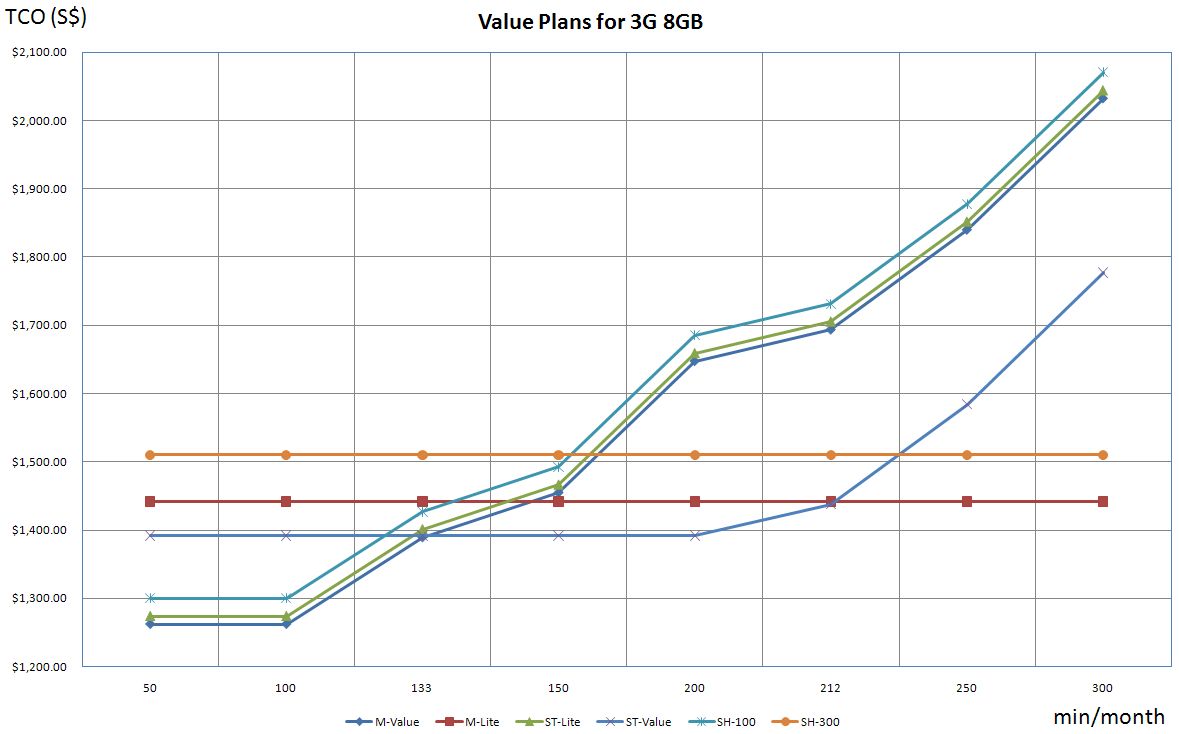
With no worry on its speed, the next concern is choosing the right plan. This model is ideal for value proposition since it has the lowest top-up value. The following table is derived.

Mins/month

M-Value

M-Lite

ST-Lite

ST-Value

SH-100

SH-300

50

$ 1,262.00

$ 1,442.00

$ 1,274.00

$ 1,391.76

$ 1,300.00

$ 1,510.00

100

$ 1,262.00

$ 1,442.00

$ 1,274.00

$ 1,391.76

$ 1,300.00

$ 1,510.00

134

$ 1,392.97

$ 1,442.00

$ 1,404.97

$ 1,391.76

$ 1,430.97

$ 1,510.00

150

$ 1,454.60

$ 1,442.00

$ 1,466.60

$ 1,391.76

$ 1,492.60

$ 1,510.00

200

$ 1,647.20

$ 1,442.00

$ 1,659.20

$ 1,391.76

$ 1,685.20

$ 1,510.00

212

$ 1,693.42

$ 1,442.00

$ 1,705.42

$ 1,437.98

$ 1,731.42

$ 1,510.00

250

$ 1,839.80

$ 1,442.00

$ 1,851.80

$ 1,584.36

$ 1,877.80

$ 1,510.00

300

$ 2,032.40

$ 1,442.00

$ 2,044.40

$ 1,776.96

$ 2,070.40

$ 1,510.00


From the graph, we observe that M1's plans beat Starhub's plans flat. If you are having an average call out of 134 to 212 minutes/month, it is wise to choose Singtel M-Value Plan. Else M1 M-Value and M-Lite plans provide the lowest TCO for the rest.

iPhone 3GS 16GB

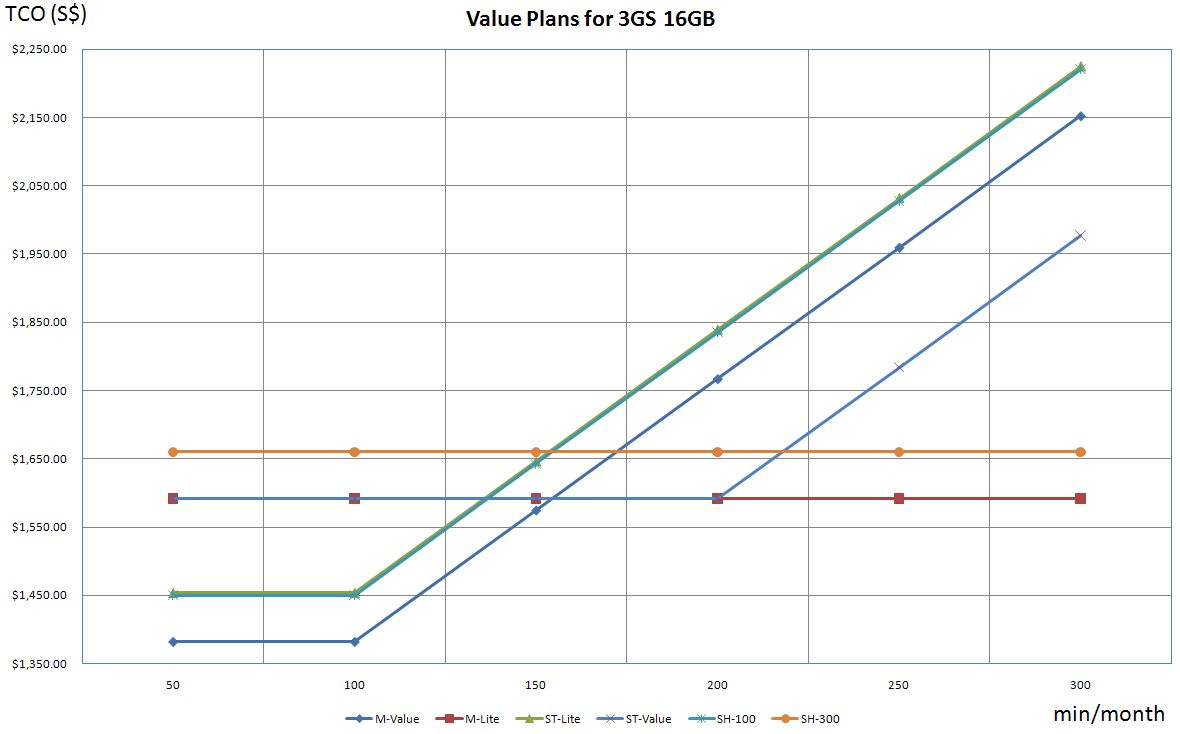
The plans for this mid end phone are presented below.

Mins/month

M-Value

M-Lite

ST-Lite

ST-Value

SH-100

SH-300

50

$ 1,382.00

$ 1,592.00

$ 1,454.00

$ 1,591.76

$ 1,450.00

$ 1,660.00

100

$ 1,382.00

$ 1,592.00

$ 1,454.00

$ 1,591.76

$ 1,450.00

$ 1,660.00

150

$ 1,574.60

$ 1,592.00

$ 1,646.60

$ 1,591.76

$ 1,642.60

$ 1,660.00

200

$ 1,767.20

$ 1,592.00

$ 1,839.20

$ 1,591.76

$ 1,835.20

$ 1,660.00

250

$ 1,959.80

$ 1,592.00

$ 2,031.80

$ 1,784.36

$ 2,027.80

$ 1,660.00

300

$ 2,152.40

$ 1,592.00

$ 2,224.40

$ 1,976.96

$ 2,220.40

$ 1,660.00


The graph depicts that both M1 plans are the clear winners in the value market except for 200mins/month, Singtel Value wins a marginal S$0.24. Now, you can tell any blind man to get M1 plan if he wants a iPhone 3G 16GB. However, Starhub SH-300 is a close competitor with M1 M-Lite with a small S$68 margin.

Conclusions

For easy reference, the TCO table for all phones and plans is shown below.

Mins/month

Lowest TCO

3G 8GB

Lowest TCO

3GS 16GB

Lowest TCO

3GS 32GB

50

$ 1,262.00

M-Value

$ 1,382.00

M-Value

$ 1,522.00

M-Value

100

$ 1,262.00

M-Value

$ 1,382.00

M-Value

$ 1,522.00

M-Value

150

$ 1,391.76

ST-Value

$ 1,574.60

M-Value

$ 1,714.60

M-Value

200

$ 1,391.76

ST-Value

$ 1,591.76

ST-Value

$ 1,741.76

ST-Value

250

$ 1,442.00

M-Lite

$ 1,592.00

M-Lite

$ 1,742.00

M-Lite

300

$ 1,442.00

M-Lite

$ 1,592.00

M-Lite

$ 1,742.00

M-Lite

450

$ 2,019.80

M-Lite

$ 2,169.80

M-Lite

$ 2,319.80

M-Lite

500

$ 2,212.40

M-Lite

$ 2,280.00

ST-Plus

$ 2,378.00

ST-Plus

700

$ 2,352.00

M-Extreme

$ 2,352.00

M-Extreme

$ 2,450.00

M-Extreme

1000

$ 3,507.60

M-Extreme

$ 3,507.60

M-Extreme

$ 3,605.60

M-Extreme

1500

$ 4,752.00

M-Unlimited

$ 4,752.00

M-Unlimited

$ 4,752.00

M-Unlimited


For the lowest TCO, your wallet will suffer a damage of S$1,262. This is the lowest price for owning a iPhone. You must refrain from abusing the data bandwidth and exceed the limit of monthly data usage for value plans.

By far, M1 plans win in nearly every category. Singtel has a few winners but Starhub has none. This clearly explains why M1 shops are crowded with human queues while Starhub shops are crowded with flies. As a smart consumer, be prepared to choose the best plan from the chart below before you join in the queue. Remember to consider M1's Take-3 plan, Free Calls to 3 M1 numbers, Unlimited SMS and MMS plus Free Campus/Army Camp calls (students and NSFs) and 35% discount on Multi-Line Saver to enjoy greater discounts.

TRUE WINNER

With the above, do you think you are the winner in this war? Unfortunately, the answer is NO. M1 laughs all the way to the bank if everyone signs up their M-value plan. Why?

From M1 perspective, they wish to regain market share as they do not complete package like Singtel's MIO and Starhub's Hubber as they do not own the infrastructure.

From consumer end, you are the "biggest" loser by choosing M-Value because it has the lowest value amongst the plans. If we only consider voice calls and SMSs, below are the perceived values of the plans based on simple calculations.


M-Value

M-Lite

M-Extreme

Explanation & Formula

Monthly Fee (w/GST)

$ 36.00

$ 56.00

$ 98.00

A

Free voice call (mins)

100.00

300.00

700.00

B=$0.1605/min

Free SMS/MMS

500.00

500.00

500.00

C=$0.05/SMS


Bundled value

$ 985.20

$ 1,755.60

$ 3,296.40

D=(free call x B)+(free SMS x C)

2 years contract

$ 864.00

$ 1,344.00

$ 2,352.00

E=24 mths x A

Cost of phone

$ 398.00

$ 98.00

$ -

F

Perceived Values (PV)

$ (276.80)

$ 313.60

$ 944.40

PV=D-E-F


So signing up the M-Extreme plan gives you a gain of S$944 as compared to M-Value plan of –$276.80. You may argue the costs of operation for calls and SMSs are much lower on the operator side. Yes, you are right and this precisely iterates the fact that you must stick to your plan and should not exceed the allocated time or data usage. So I hope these tables will assist you in selecting a good iPhone as well as a good plan to complement it.

Thursday, 10 December 2009

Select your best iPhone 3GS 32GB plan…

Telco war

Peace is disrupted yesterday when all 3 telcos are selling iPhone. OCWORKBENCH is the first in Singapore to report live on the iPhone war with a nice chart breaking down the various plans offered by the 3 telcos. If you follow their twitter, you can be updated on last minute surprises offered by M1 and Starhub to sweeten their offerings. Many Singaporeans are queuing up to get their iPhone because monkeys see, monkeys do (as they said in the army). If you are one of them, do you know what plan is suitable for yourself? Or you just sign the cheapest plan to get your dream iPhone?

Factors to consider

I have earlier blogged on some concerns before you upgrade your phone or plan. Perhaps it is good for you to read it before you run down to queue up. It is important that you are sure that you NEED a iPhone before you read further on the plans offered. Many claimed that marketing department in Apple is doing a great job in pushing you a product that you don't need. So don't jump on it if you only make voice calls and send SMSs. It is trendy to carry the latest model 3GS but you look stupid if you have no applications using the data plan. Yes, all iPhone plans come with minimum 12 GB of data plan which is great if you use GPS, MSN, Email, Surf web, Twitter, Internet radio, YouTube, Facebook and watch internet TV. 12GB is a lot of data and most users are unlikely to exceed this quota in a month. Thus, we will not be considering data transfer in our tabulation.

I would like to introduce a term known as the total cost of ownership (TCO) in our evaluation. TCO includes the monthly subscription (voice and data) you are paying and the cost of the phone. It is only fair to compare different plans as there is an amount to pay for the price of the phone for different plans. Below is an example of the Singtel iPhone plan for 3GS 32GB.

iPhone 3GS 32GB

Lite

Value

Plus

Premium

Monthly Fees (S$)

39.00

55.99

95.00

204.99

Extra cost for phone (S$)

658.00

398.00

98.00

0.00

TCO for 2 yrs contract (S$)

1,594.00

1,741.76

2,378.00

4,919.76

After you confirm iPhone is suitable for you, you should consider how many calls you make a month because this is one of the determining factor in various plans. If you are a light user, a 100 minute/month plan may be suitable for you. If you are a heavy user, you should consider the unlimited plan. It may be a good time to take out your mobile bills for the past year and calculate how many minutes you use per month. With this, let's begin to search the best plan for iPhone 3GS 32GB.

Value Plans (<300 minutes/month)

As the name suggests, this plan is suitable for consumer with a budget or makes only few calls. If you choose this plan and use more than 300 minutes, you will be paying a dear premium. So if you use 350 min/month, it is strong advised to select the next higher plan. Based on TCO on the plans offered by telco, the table is derived.

TCO

M-Value

M-Lite

ST-Lite

ST-Value

SH-100

SH-300

50

$ 1,522.00

$ 1,742.00

$ 1,594.00

$ 1,741.76

$ 1,580.00

$ 1,810.00

100

$ 1,522.00

$ 1,742.00

$ 1,594.00

$ 1,741.76

$ 1,580.00

$ 1,810.00

150

$ 1,714.60

$ 1,742.00

$ 1,786.60

$ 1,741.76

$ 1,772.60

$ 1,810.00

200

$ 1,907.20

$ 1,742.00

$ 1,979.20

$ 1,741.76

$ 1,965.20

$ 1,810.00

250

$ 2,099.80

$ 1,742.00

$ 2,171.80

$ 1,934.36

$ 2,157.80

$ 1,810.00

300

$ 2,292.40

$ 1,742.00

$ 2,364.40

$ 2,126.96

$ 2,350.40

$ 1,810.00


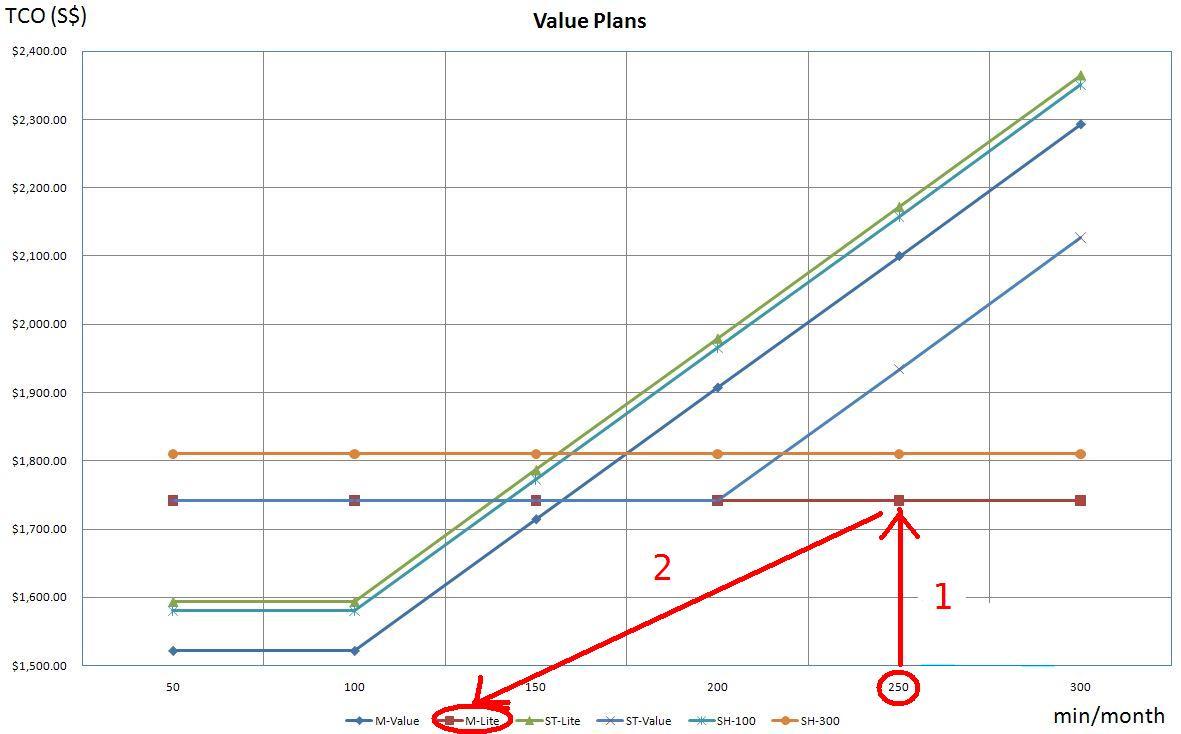
This above picture shows the TCO of the value plans. The lower the TCO, you pay lower. So with the min/mth value in the x-axis, move vertically up and the first line you touch is the best plan you should get.

From the graph, you should get M-Lite plan if you using an average of 250 minutes/month. Note that the TCO increases drastically if you exceed the voice minutes in your plan.

Premium Plans (>300 minutes/mth)

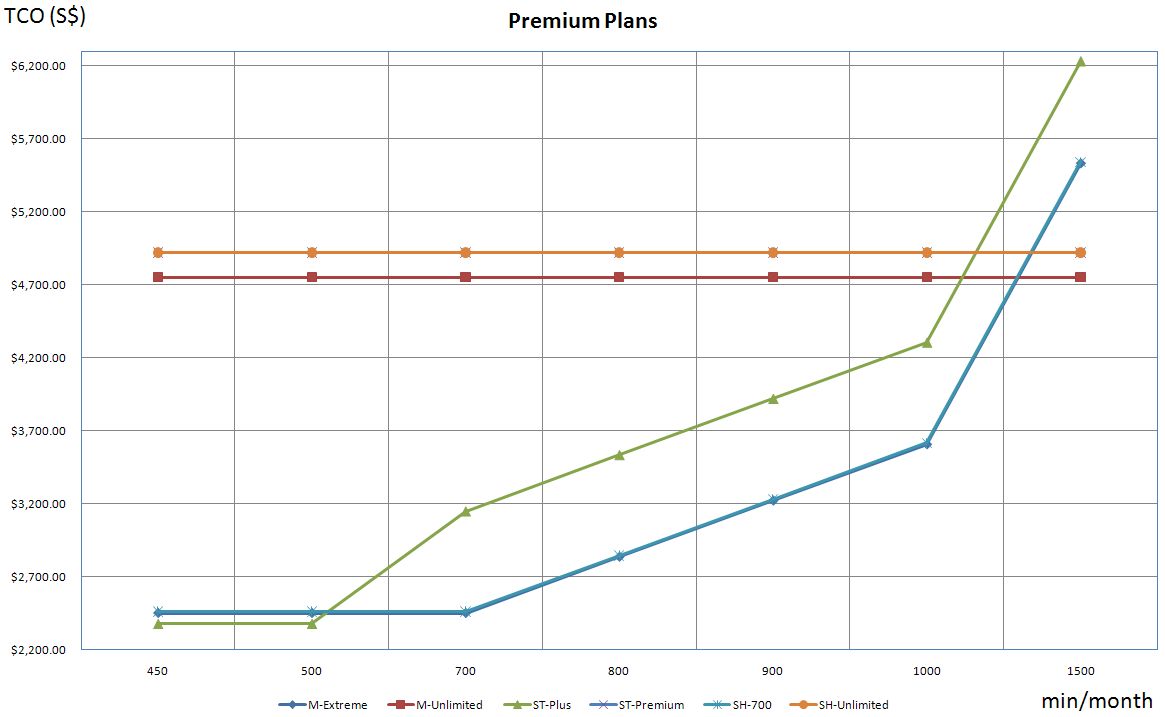
Next, we shall consider the premium plans which range from 450 to unlimited minutes/month. The following table is derived.


M-Extreme

M-Unlimited

ST-Plus

ST-Premium

SH-700

SH-Unlimited

450

$ 2,450.00

$ 4,752.00

$ 2,378.00

$ 4,919.76

$ 2,460.00

$ 4,920.00

500

$ 2,450.00

$ 4,752.00

$ 2,378.00

$ 4,919.76

$ 2,460.00

$ 4,920.00

700

$ 2,450.00

$ 4,752.00

$ 3,148.40

$ 4,919.76

$ 2,460.00

$ 4,920.00

800

$ 2,835.20

$ 4,752.00

$ 3,533.60

$ 4,919.76

$ 2,845.20

$ 4,920.00

900

$ 3,220.40

$ 4,752.00

$ 3,918.80

$ 4,919.76

$ 3,230.40

$ 4,920.00

1000

$ 3,605.60

$ 4,752.00

$ 4,304.00

$ 4,919.76

$ 3,615.60

$ 4,920.00

1500

$ 5,531.60

$ 4,752.00

$ 6,230.00

$ 4,919.76

$ 5,541.60

$ 4,920.00


With the graph, we can see the TCO for such plan has a minimum of S$2,378. So you should be signing for either M-Extreme or SH-700 if you are using 800 minutes/month.

Limitations

There are limitations in this method which should be factored in. Different telcos offer different candies to sweeten the products. M1 has Take-3 plan, Starhub has free TV channels while Singtel has other plans with MIO bundling. This analysis only consider iPhone 3GS 32GB and not 3G 8GB and 3GS 16GB.

Conclusions

To assist you in selecting the plan, the table below will help you in selecting your plan. You will also be able to know your damage in owning a iPhone 3GS 32GB.

mins/mth

Lowest TCO

Plan

50

$ 1,522.00

M-Value

100

$ 1,522.00

M-Value

150

$ 1,714.60

M-Value

200

$ 1,741.76

ST-Value

250

$ 1,742.00

M-Lite

300

$ 1,742.00

M-Lite

450

$ 2,319.80

M-Lite

500

$ 2,378.00

ST-Plus

700

$ 2,450.00

M-Extreme

800

$ 2,835.20

M-Extreme

900

$ 3,220.40

M-Extreme

1000

$ 3,605.60

M-Extreme

1500

$ 4,752.00

M-Unlimited

Looking forward, I predict that with iPhone setting the precedence, data plan will be more affordable to the masses and Singaporeans will be able to try and apply applications in their daily life. After all, Singapore is a small island and well connected wirelessly. We should be able to surf internet while on the move. Having said that, prices will only get lower so I see that there is no need to rush and get a iPhone. Spend some time in reading this blog and understand your needs is better than getting a white elephant which will eventually pass down to your children or your parents when you are sick of this "hi-tech" toy. If election deserves one cooling off day, so do you.

Featured Post

BlueSG vs CarShare

BlueSG vs CarShare Since 12 Dec 2017, the first electric car rental has started business in Singapore and there is no need to pay for petr...