Showing posts with label Singapore. Show all posts

Saturday, 22 December 2018

Register for TPG Telecom now!

Good news

After the last posting on advicing NOT to sign up for new plans, TPG has announced on 21 Dec that they will start its registration process for its new subscriber base.  The first 20k subscribers are expected to use its mobile service for 1-year FREE.

Who is TPG Telecom?

TPG Telecom is the 4th mobile operator in Singapore.  Founded in 1986 and started mobile operation in 2008, it is the 2nd largest Australia fixed Telco with 400k subscribers.  Unlike Zero, Zero1 and CircleLife, TPG has its own fixed network infrastructure so it has full control over its network.

U-Turn on 24 months Senior Plan

They also claimed they are commited and look forward to contribute to the community.  In Mar 2018, they mentioned about 24 months plan for seniors above 65 years old but made an U-Turn on that decision.  Further details will be available.

What the plan offers?

20,0000 successful applicants will be expected to get the following plan:
  1. 20 minutes of outgoing calls;
  2. 20 SMS; and
  3. Unlimited mobile data but above usage of 2GB will be throttled to 1Gbps.
Note: To watch a youtube video with powerpoint effect, a 2Gbps speed is needed.  Therefore, after 2GB, online high resolutions video will be expected to lag.

Target Segments

Based on the free plan, the target segments they are aiming are:
  1. People with low calling and low sms needs;
  2. Users with IoT or GPS devices;
  3. Seniors or teenagers; and
  4. Adults with a secondary line.

Conclusions

Looking at all plans offered by all competitors, there is no plan to match at such low price point unless you are paying S$9.90 with Zero1.  So, successful applicants stand to gain $120 for the free 1 year access.  Why wait? Register now to avoid disappointment.  Good luck to your application!

Tuesday, 19 December 2017

BlueSG vs CarShare

BlueSG vs CarShare

Since 12 Dec 2017, the first electric car rental has started business in Singapore and there is no need to pay for petrol anymore.  BlueSG has launched 80 cars and 30 charging stations all around Singapore with overwhelming responses of more than 2000 users.

BONUS: If you are a first time user of BlueSG, you may wish to click HERE for the unofficial user guide of BlueSG.

HOW TO CHOOSE?

So which provider should you choose? Let's compare the differences.

COLLECTION AND RETURN

The unique part is the option to return the car in other location apart from the collection point.  The locations of the BlueSG seems more convenient as compared to other car share.  Conventionally, cars from CarShare are parked on the high storey and it waste time with longer distance just to drive up to the 5th or 6th floor of Multi Storey Car Park (MSCP).  BlueSG seems to be located at level 1 of MSCP or along the road.

ELECTRIC VS PETROL

This is obvious as BlueSG needs no petrol to run its fleet.  However, electric car needs longer time to charge so turn around time for electric car is not immediate.  When the battery of the electric car is 30%, the user will be prompted to return the car to its charging station bearing in mind the maximum distance the car can run is 200 km for a full charge.  Since Singapore is burning coal to generate electricity, electric car may not be environmentally friendly but this is beside the point.

SUBSCRIPTION FEES

The subscription model is as follows:
Annual plan - S$15/month - S$0.33/min for a minimum of 15 minutes
Weekly plan - S$0/month - S$0.50/min for a minimum of 15 minutes

FEATURES OF ELECTRIC CARS

There are few distinct impressions after driving an electric car. The first being speed pickup is great but the speed can decrease rapidly when the accelerator is not stepped. The second impression is you must use handbrake on a slope else you will slip backward.  The surprising fact is the full electric car is not as silent as expected without the engine as compared to a hybrid car.  Due to the drag, the car feels heavy and solid.  Perhaps this is the intention of the car manufacturer as it is capped at a speed limit of 90kmph.  Although it is a four seater car, it is tight to sit behind as the 3rd and 4th passengers due to the small confined space and the lack of the hind doors.

AVAILABILITY

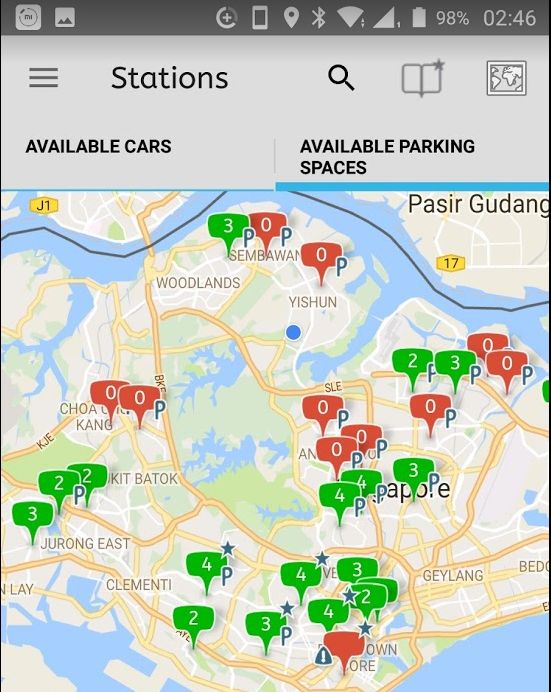
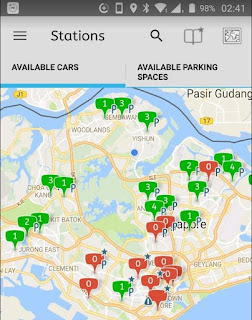
It is interesting to note that it is nearly impossible to book BlueSG near the city after dark (and vice versa).  Apparently, many, living far from city, drive the cars back to home.

Only 1 car to book near city at 3am

  Therefore, during office hours on weekdays, it may be challenging to get a BlueSG car from Woodlands, Punggol or Jurong as all the cars are in the city areas.

There are parking issues at few locations after dark.

The other booking issue is the accessibility of BlueSG cars as most of the locations are not situated near MRTs or LRTs.  They are well hidden inside HDB car parks and it may take 15 minutes to locate the charging station as the locations of BlueSG are somehow misleading (for example: Blk 73 Redhill Road is marked at Blk 74 Redhill road).

The location of Blk 73 is wrongly indicated.
The correct location is indicated by the RED CROSS CIRCLE.

Due to the geographical limitation and the number of parking spaces, it will be foolish to just book and ignore the parking consideration.  You may reserve a car easily but when you intend to return the car, you find that there is no space in the vicinity of 10km radius.  By parking at a distance, you may need to take a taxi back and it defeats the purpose of renting a car altogether.

USAGE CHARGES

At first glance, BlueSG is more expensive than any other car share services offered since it is charged by the minutes.  If you are driving for more than 1 hour, it is better to select car share over BlueSG to save costs.  Car share services also offered special promotions (business hours on weekday or owl special) which are superior over BlueSG plan which is charged by minutes.

DURATION

BlueSG offers shorter duration as compared to Carshare. Since BlueSG charges by the minute, it is increasingly expensive to keep using their service as they do not offer promotions like Owl special or Business Promo in weekdays.  Their focus and strength lies in below 1 hour of driving from Point A to Point B. This begs the question why should user choose BlueSG over Taxi, Grab or Uber?

CONCLUSION

BlueSG may not have the absolute advantages over other Car Share services, it must offer competitive pricing to attract users to stay with the service.  In the end, the winners will be the consumers who have another choice when the MRT breaks down again.

Friday, 27 October 2017

Top 10 reasons why you should not buy flagship phone in Singapore

Why chasing after flagship phones?

Many are chasing the latest iPhone X or Pixel 2 XL which will be launching soon in end 2017. The local telcos are also rushing to come out with phone plans using the old models to lock their loyal customers for another 1-2 years. Little do the customers know that this old business model is silly and no longer apply to this new world of technology.

Reason 1: Warranty of Phone is only 12 months but contract is 24 months

The warranty of most of the phones are 12 months but the contract is 24 months.  This implies that the high-end phone has no warranty on the 13th month onwards.  Most of the electronic parts seldom break down in the first 12 months and that's why manufacturer are committed to service their phone within the first 12 months.  Why should you sign a 24-month contract to buy a 12-month warranty phone?

Reason 2: Premium phone is sold at a premium during launch

All phones are sold at the highest point to capture the trend setters who buy the story of the manufacturer. After 3-6 months, discounts will be available for the phone and prices will gradually decrease over time.  Why should you buy the phone at the highest point? To support the manufacturer and show off to your friends?

Reason 3: There is no room for discount for a low monthly plan

If you are paying below S$45/month for your phone bill, there is no benefit of getting a high-end phone. The maximum subsidy you enjoy is only S$200 but you must fork out over S$1000 up front. The lowest tier does not enjoy any benefits and are always the last group of customers that the telco serviced.

Reason 4: Use up monthly data in less than 2 seconds!

For high-end phone, they are capable of delivery bullet speed data.  Pixel 2 XL is a CAT 11 4G LTE beast capable of transferring 500Mbps across Singapore.  Given 100MB of data per month under Singtel COMBO 1 plan, you can use up your monthly allocated data in 1.6 seconds. Even if you are having the COMBO 12 plan (S$239.90/month), you only take up 192 seconds or 3.2 minutes to consume your 12GB monthly quota. This sucks!

Reason 5: Features you seldom use

New phones come with many features like NFC, 4k video recording, Face ID, iBeacon micro location, 2.5D, iWatch app and many others which you seldom use. Why pay so much more for something you use once in a while?

Reason 6: Small battery size

The irony of small form factor (<3000mah 2="" a="" about="" after="" and="" bank="" battery="" big="" bigger="" buy="" continue="" day="" div="" for="" forget="" get="" half="" has="" hours.="" hrs="" in="" is="" just="" last="" nbsp="" need="" not="" of="" or="" order="" phone="" power="" recharge="" remaining="" sell="" small="" sufficient="" the="" to="" when="" which="" why="" work="" working="" you="" your="">

Reason 7: High repair costs

Many of the new phones have double sided glass for premium aesthetic look and feel. They are easily contaminated with fingerprints and once it is cracked, the costs of repair can cost up to S$500 since you need to replace glasses on both sides of the phone.

Reason 8: Electronic parts have lifetime

Smartphones are electronic products which are made up with active and passive components. Active and passive products have a lifetime and once their lifetime is up, they will no longer function as required. The design of the phone is also important in determining its product lifetime.  It is a miracle for these designs to last more than 10 years. So it is unwise to buy a high end phone.

Reason 9: Battery cannot last more than 5 years

Most batteries depreciate after extensive use and the lifetime of battery cannot last more than 5 years.  If the design of the battery compartment is small with no allowance for expansion due to heat or pressure, explosion incidents may happen similar to Samsung Note 7.

Reason 10: The next flagship product will be launched tomorrow

There is no end in chasing flagship product.  The moment you buy the current flagship, it will depreciate 10% to 20% on the same day and the next flagship product will be launched tomorrow. Remember: Technology travels fast.

Sunday, 3 April 2016

The logic of traffic lights in Singapore

Background and facts

In 2 Jun 2011 at around 10pm, 21 year-old National Serviceman Li Jianlin was knocked down by taxi driver, Mdm Asnah, 59 at a pedestrian crossing in Bukit Batok West Avenue 5. He suffered serious head and hip injuries and was hospitalised for 3 months.

The cab's insurer appealed with lawyer Anthony Wee arguing that Mr Li should be 35% to blame for failing to check for approaching traffic as he crossed the second half of the dual carriageway which had a centre divider.  Mr Wee citied rule 20 of Highway Code: "Where a pedestrian crossing has a central refuge, each half is a separate crossing and you should treat it as such."

Judge of Appeal Chao Hick Tin and Justice Quentin Loh pointed to rule 22.  It requires pedestrians at a light controlled crossing to wait on the footway until the traffic in front has come to a standstill. This means those on foot should keep a lookout for errant motorists regardless of how long the lights have turned in favour of the pedestrian, wrote Justice Chao.

Chief Justice dissented and the Court of Appeal decision is 2-1.  The judgement means that when the case is returned to the High Court in September, the sum will be discounted by 15%.

In short, pedestrians who failed to check for incoming traffic at the traffic light junction has a 15% responsibility for any accident.  (Ref: Straits Times news article)

Maths perspective from the pedestrian

PedestrianWatch out for trafficResponsibilityChances of being knocked down
Traffic LightNo15%>0%
Traffic LightYes15%0%
No Traffic lightYes>15%0%
From the perspective of the pedestrian, pedestrians have 0% or no chance of being knocked down if we watch out for all incoming traffic before we cross at traffic light junction.  But if we fail to watch out of traffic and was knocked down by any vehicle who is speeding and beating red lights, pedestrians are accountable for 15% at traffic light junctions.

Maths perspective from the driver


DriverBeat Traffic LightResponsibilityChances of knocking down someone
Traffic LightNo85%0%
Traffic LightYes85%>0%
No Traffic LightNo<85 td="">>0%
From the perspective of the driver, there is no chance to knock down someone if they do not beat red light.  Even if they beat red lights and knock someone down, they are only 85% responsible for the accident.  As such, it is logical to deduce that when accidents occur at non-traffic light junctions, the responsibility of the drivers should be less than 85% because pedestrians fail to cross at traffic light junctions or they may be jay-walking.

Conclusions

Understanding the perspectives of both parties, it is apparent the following questions remain:
  1. From the pedestrian's argument, why do we need to install traffic lights if it is safer to cross the road at non-traffic light junctions since the key to safe crossing is watch out for incoming traffic?
  2. From the driver's argument, it is okay to beat traffic lights as the pedestrian bear 15% responsibility if accident occurs.  In most cases, the driver is 100% responsible for knocking down someone in non-traffic light junctions.  Again, why do we need to build traffic light?
The decision of the Court of Appeal will set precedence for future accident claims and if pedestrians cannot cross traffic light safely when they see the green man, they should try to cross the road when they see red man.  They just need to watch left, watch right and watch left again, to make sure no policeman or vehicle is coming for them!

Saturday, 13 December 2014

The best FREE GPS navigation app for Android in Singapore

The demise of GPS devices

With the popularity of GPS app in mobile phones, standalone GPS devices are slowly fading away giving in to the integrated GPS app.  Hardware wise, high end mobile phone are much more powerful than conventional GPS devices with enough storage and computing strength.  The only question is what app to consider.

Who needs GPS navigation?

Some may argue that Singapore roads are straightforward and well routed rendering GPS navigation unnecessary.  They fail to factor in new ERP gantries set up in new locations, the ever changing traffic conditions, new speed cameras trap, new red light detection cameras and road diversion or closure due to events or construction.

Unless you are travelling short distance to and fro work from home, you may need a good mobile GPS app to save you time and money on the road.  Anyway, most of these apps are free.

If you are just interested to get the location details of a specific area, GPS app will also come in handy to provide what are the amenities available in the area. 

Competition of GPS Apps

There are many GPS apps around the world but many are restricted and optimised for regional use.  In Singapore, the most popular are listed below:
  1. Waze, Free
  2. Here (Nokia), Free
  3. Maps (Google), Free
  4. Galactio SG, Free
  5. Maps.me, Free
  6. NAVFone GPS SG (AGIS), S$6.99
  7. Papago! GPS, S$37.43
We shall evaluate the first 5 apps as the remaining are paid apps.

WAZE

Developed by Israeli startup, Waze is acquired by Google in 2013 and it taps on the social strength for real-time traffic update.  With many users around the world, real-time traffic are gathered and captured and later used to assist users to determine the best route to their destinations.

When mobile data is present, users can actively update traffic status to the server and share with other users.  When mobile data is absent, map update and re-routing are not possible.

HERE

Formerly known as Ovi Maps and Nokia Maps, HERE has covered nearly 200 countries and just exit beta testing phrase in Android platform.  One of the strength of HERE is they have existing Places of Interests (POIs) which are valuable for searches and locating purposes.  Even when mobile data is not available, offline access and navigation are possible.

GOOGLE MAPS

Maps is a de facto app in all Android phone well integrated in the Operating System (OS).  The navigation capability is great but marred by the local expertise and the update frequency.  Generally, it is a best 2nd alternative if you have no primary GPS app.  Another drawback of Google Maps is the compulsory requirement of mobile data else it is an useless app.

Galactio SG

In Nov 2010, Land Transport Authority (LTA) Singapore released the location table and Quantum inventions include traffic incidents information, traffic speeds, parking availability, weather, road closures etc inside this app.  The presumption is you must have mobile data plan to enjoy such updates before and during the drive.  With data plan, there are 5 modes of transport whereby you can choose either the shortest, fastest, toll avoidance, toll minimised or traffic aware mode.

Maps.me

This is a great offline map tool created in Moscow, Russia.  The map origins from OpenStreetMap and the app provides navigation without voice.  Bookmarks are easily created and navigation can be provided completely without data plan.  GPS is afterall free for use.  Worldwide maps can be downloaded for free and the details are realistically practical for use.  If you are touring a country, it is a must have app to put in your phone.

Which app is for you?

Based on the comparison table, we come out with the following recommendation:

  1. Waze: This is the best app for social traffic update and sharing of your location if you have data plan.
  2. HERE: For those without mobile data plan, this is a must-have app if you are driving overseas.
  3. Google Maps: This is the backup app we propose.
  4. Galactio SG: This is our winner for daily use in Singapore provided you have mobile data plan and a smartphone with 1GB ram.  You are able to avoid all toll and EPR charges while driving.
  5. Maps.me: This is the best app if you are travel overseas.  Download it before you leave town.  It will be handy even if you are not driving.
Leave your comments if you have some doubts.  Travel safe.

Wednesday, 20 January 2010

Quality of Life in Singapore 2010


Quality of Life Index

A recent study attempts to rate and rank the best places based on Quality of Life Index of 194 countries. The author acknowledged that this rating is western-biased and compare 9 factors to derive a score. The top 5 countries are France, Australia, Switzerland, Germany and New Zealand. Surprisingly, Singapore is ranked numerically 70th and the printed media has no report on this study till now. Is there a mistake or the biased factor resulted in such low ranking?

Positioning and Rank

As Singaporeans, we are trained to think position is everything. In this case, the ranking system will be our first focus. Naming Singapore at 70th position is incorrect because for the same scores at 61, there are 6 countries. If we give the same rank for the same scores, Singapore is ranked 21th out of 194 countries. We notice an improvement but should we deserve better? A peek into the formula shows the index does not have any decimal points. Perhaps providing decimal will give a clearer picture. However, when the formula is applied, we failed to derive the same results as the study. Nonetheless, the formula shows that Singapore is ranked 56th position with a score of 57.35. So we are standing at the top 28.87% of the Quality of Life survey. Is that the complete picture?

Review of the factors

Instead of squeezing the figures to climb higher in the ranks, let's try to review our weaknesses and improve on them. Let's dig more:
  1. Cost of Living (ranked 29 out of 47)
    We scored badly in this category. This factor is tagged to the lifestyle in US so having a lower position than US means that our cost of living is worst than US. Looking at the inflation of goods and services, our daily expenses are higher than yester years and we may be having a lower score next year for this category. Singapore, an open economy, is vulnerable to economy jitters and shakes. As almost everything is imported from elsewhere, there is little chance of making this category better except making Singapore dollars stronger than other currencies thus making things cheaper. So if you step out of Singapore, you will realized Singapore dollars is strong as compared to many other currencies. (Side note: Sweden has a rating of 0?)
  2. Leisure & Culture (ranked 17 out of 66)
    Singapore is ranked above average in this sector but I consider this one of our potential weaknesses. One may argue that visiting museums and reading newspaper may not be our national pass time. The internet era of wireless network has changed our lifestyle in obtaining news and updates via twitter and television against the conventional printed media. However, most Singaporeans will agree with me that we have limited recreational activities besides watching movies in cinemas. Nearly all activities that can attract people are indoor-based else Singaporeans will refuse to participate. Perhaps the hot humid weather is to blame as well.
  3. Economy (ranked 10 out of 34)
    Singapore has strategic focus on economy and we have scored well in this category. Isn't it surprising to learn that a small island is ranked top 10 in the economy field? In contrast, Iceland which has already bankrupted is ranked 31 out of 34. Strangely, US, technically bankrupted, still ranks 11th behind Singapore. Interestingly, China is ranked 9th and is leading us. The lion has woken up.
  4. Environment (ranked 34 out of 44)
    Despite being Singapore named Garden City, our score is very disappointing in this category. Being small is our constraint. Even with excellent city plans and implementation, we fail to register a good image in this study. But everyone agrees that the National Parks has done a good deal in greening the environment we live in and provides excellent facilities for residents. Now, have you wonder why there are no butterflies in a garden city? Perhaps the fault lies in the residents themselves.
  5. Freedom (ranked 8 out of 13)
    In a democratic society, Singapore is ruled with laws to maintain order. Comparing to the west, perhaps the political climate of one party rule is not favourable to the west and therefore, we are ranked lower in this category. Taiwan, where opposing politicians fight amongst themselves in parliament sessions, is ranked second. The question is do we want to follow their footstep.
  6. Health (ranked 17 out of 72)
    With an increasing graying population, this category is a worrying concern in the near future. So far, we did well in this category but the cost of making sure Singaporeans is alive is higher than the burial cost. Singaporeans will live longer than their parents but more costs will be spend in making sure of that. So investing in your health is more important that investing in your finance portfolio.
  7. Infrastructure (ranked 15 out of 43)
    We have an above average rating in this category assisted by the 100+% mobile ownership and the good transport network. However, there is a high price tag we are paying to enjoy and maintain such facilities. If more vendors are in the market, healthy competition will drive cost down and consumers will benefit more.
  8. Risk & Safety (ranked 1 out of 15)
    This is the best category Singapore has scored and ranked 1st. However, 56 countries scored full marks so there is nothing to be proud of. The challenge is to maintain our position else our position will be 57th next round. The parties responsible shall lies with the Police and security departments and so far, they are doing a great job with low crime rates for years.
  9. Climate (ranked 54 out of 76)
    There is nothing we can do to change the hot humid weather, rainfall and 32 degrees celsius. Our only comfort is Singapore is blessed with no major natural disasters. On this point, it is strange to note that Indonesia is ranked 14th in this category with live volcanoes and occasional earthquakes.


Conclusions

Singapore, a tiny island, with no natural resources has scored well in this study considering its inherent limitations. The study aims to bring out the best places to live in the perspective as a foreigner. If you intend to migrate, this index will be very useful to you. But if you are a local, it is just a gauge of how attractive is your country to potential immigrants. Singapore adopts the foreign talent policy so it is important to improve our scores in all categories to make Singapore a better place to stay – for both locals and foreigners.
For you and me, everywhere is the same as long as your loved ones are beside you. This is all that matter.

Thursday, 12 November 2009

The Best Prepaid Card for Singaporeans in West Malaysia


Update (27 Jan 2016): More Telcos have joined the competition and various factors are being considered. Many of the points below are still valid for your consideration. It is suggested that you read this before reading the new post.

Do I need a local prepaid SIM card?

Malaysia is the best getaway for Singaporeans despite increasing robbery incidents. However, Singaporeans are not daunted due to the ever increasing exchange rate versus Ringgit as Singapore Dollar becomes stronger over the years.
No matter if you are going to shop and pump petrol in Johor Bahru, enjoy a sweet vocation in Muar or Melaka or venture to Penang or Langkawi for holidays, you are constantly with your mobile to remain contactable. Roaming charges to dial back Singapore may range from S$0.60/min with S$10/mth roaming charges for postpaid customer or S$2/min for prepaid customers. The damage is higher if you are calling another friend who is travelling together with you in Malaysia who is using a Singapore mobile. Both sides are paying for roaming and the only way to reduce the bill is buying a prepaid local SIM card, especially for long or extended trips.
The obvious advantage of owning a prepaid SIM card is you do not need to pay for incoming calls. Need we say more?

The choices

There are 5 operators in Malaysia offering different prepaid services for travellers but not all the plans are suitable for Singaporeans. There are many Malaysians who are working outside their home states and buying a prepaid card is also their choice. Some plans are suitable for long terms use while many are suitable for short term use (ie Singaporeans). Below are the operators, their respective sites and unique selling points:
Happy – www.happy.com.my (lowest call out value for 15min @RM0.99)
Celcom – www.celcom.com.my (widest network coverage in Malaysia)
Digi – www.digi.com.my (auto reload of value)
Maxis – www.hotlink.com.my (3.5G data use)
U Mobile – www.u.com.my (per second billing)

The Needs

For a typical Singaporean, voice communication is all he/she needs. Ideally, we would like the following features for the prepaid SIM card:
  1. Low startup cost to own a prepaid SIM card;
  2. Low charge to call back Singapore;
  3. Low charge to SMS to Singapore;
  4. Low charge to call Malaysia landline or mobile;
  5. Low charge to SMS a Malaysia mobile;
  6. Low recharge value;
  7. No expiry date of the SIM card;
  8. Easy availability of recharge stations;
  9. Good after-sales services;
  10. Easy registration process;
  11. Good coverage in city/rural areas; and
  12. No cost to call the call center.
For Singapore drivers (GPS) or wish to surf the net via GPRS/3G/3.5G may have additional requirements on top of the above:
  1. Good 3G/3.5G coverage;
  2. Consistent link to network;
  3. High bandwidth (both upload and download); and
  4. Low cost in data plan.
Unfortunately, we can only wish the above but none of the operators meets all requirements. Therefore, we need to compromise and set different priorities for different needs.

For Singaporeans visiting city area (KL, Melaka, Johor, Penang etc)

Smaller companies are only focusing on city areas with exceptional good rates for voice and text communications.
U Mobile 018 charges RM0.42/min for voice or video call out rate nationwide in 1-sec block and RM0.08/SMS. Starting pack is RM6 with RM5 for 7 days. IDD call to Singapore costs only RM0.54/min (current promotion till 31 Dec). Minimum reload is RM10 for 10 days and calling to the call center is free. The use of 3G services (max 384kbps) is charged at RM0.01/kB which is not mentioned in the website. Free bundled VAS i.e. Voice Mail, SMS, CLIP, Call Wait, Call Hold, Missed Call Notification, Call Conferencing, Call Forwarding, auto activation of IDD are also thrown in to make this offer attractive.

Happy is another option with RM0.33/min and max at RM99 for 15min for voice call nationwide. You can reload any amount for 60 days validity. For long call, you only pay RM0.99 for 45min from 9am to 5pm. Starter Pack costs RM30 with RM30 value and reloading is easy. However, international call to Singapore costs RM5/min and RM0.33/min is charged for the call center. Clearly, Happy is not interested in Singaporeans.
U Mobile stands out as the perfect choice for Singapore who visit Malaysia for less than 7 days and only use voice communications with option for 3G services.

For Singaporeans who frequently visit sub-rural areas in Malaysia

There are 3 operators in this league. Since network coverage is the critical concern in sub-rural areas, we can only consider Celcom, Maxis and Digi. The interesting feature offered by the big boys are the friend concept where you can have friends at a discounted rate.
Celcom is the recognized leader of GSM coverage in west Malaysia and yet the network is below 80% of the entire Malaysia. This is reasonable considering the rural requirements for mobile use are non-existent so it is not cost effective to support these areas. Celcom has 3 different prepaid plans (Xpax, Blue and prepaid Broadband) to meet different needs. The top 3 advantages, besides widest coverage, over the competition are highest number of friends for discounted calls, lowest unlimited data value of RM6/day or RM20/7 days and RM50 for 2 years validity. In particularly, 2 years validity is a good offer for Singaporeans who frequent Malaysia because if you forget to top up, the card, together with the value inside, will vanish in thin air. For unlimited data over 7 days at RM20 is also good value considering a 5-star hotel will charge you RM20/day for in-house limited wifi. Drivers can also have a faster lock to the GPS with their smartphone with a-GPS function via 3G. One obvious shortcoming is Celcom restricts prepaid user to use 3G network which limits to 384kbps. For voice call, Celcom charges at 60 sec block compared to U Mobile's 1 sec block. The card will be suspended 100 days after last reload.
Hotlink is the 2nd best option with reasonable coverage targeting many Malaysian teens. It prices itself close to the leader with slightly better values of RM0.33/min for local calls and RM0.35/min for outstation calls. A deeper look reveals that Hotlink's calls are much cheaper than Celcom and Digi over time. Moreover, it offers ad-hoc data plans at RM0.01/kB, RM8/day or RM25/7 days. The slightly higher cost is due to the 3.5G network offered by the network, which allows users to tap on the HSPDA network and surf at 7.2Mbps which is nearly 20 times faster than the nearest competition. The minimum top up is RM20 and RM33 for 1 year validity. IDD to Singapore is charged at RM0.5/min.
Digi is last player which fails to threaten the leaders. It offers RM0.36/min flat at 30 sec block and RM0.10/SMS nationwide. It charges unlimited data at RM5/day via EDGE (max 384kbps). IDD call to Singapore is RM0.28/min and minimum recharge is RM10. It also offers RM30 for 1 year validity and suspension is 90 days after last reload. There is no highlight in its prepaid offering and therefore should be avoided by Singaporeans.

Conclusions

It is clear that U Mobile 018 is suitable for Singaporeans who seldom visit Malaysia and just pop into the city with infrequent data needs. For frequent travellers, Celcom (Xpax or Blue) seems to be the clear winner for network coverage while Maxis's Hotlink is the clear winner for data if you need 3.5G speed.
If your family members are travelling with you, why not get them a U Mobile 018 prepaid to contact them when you are lost in the crowded city areas? If you are driving into West Malaysia, a prepaid Hotlink card enables you to search for the online review of a food outlet. You can even track your friends' locations via GPS and 3.5G combined live on your mobile in real time. Try them with your Singapore postpaid SIM card and I assure you will faint after receiving the exorbitant roaming charges.

Featured Post

BlueSG vs CarShare

BlueSG vs CarShare Since 12 Dec 2017, the first electric car rental has started business in Singapore and there is no need to pay for petr...