Sunday, 11 February 2018

Get your free 20GB Unifi prepaid simcard

The headache for Malaysia prepaid simcard

Whenever you wish to use your sim card when you are in Malaysia, the first problem you encounter is TOP UP. Yes, before you use it, you must top up the sim card...if it is still valid within 50 days since your last use. If you never top up for more than 50 days, the simcard is dead and all its credit, data, call and sms credits are confiscated.

So if it is still within 50 days since its last top up, you will probably first top up with RM10 in 7-11 store in Malaysia and then consider buying some data for use.  You have to utilise your credits and purchase RM10 for 10 days of validity.  That's right. Your RM10 can use for another 10 days and you cannot make outgoing calls on the 11th day but you can receive calls or sms in the next 50 days.

The cycle and the frustration repeats itself every 50 days.  This nightmare will not longer haunt you if you get the new TM unifi prepaid simcard.  Read on for more details.

Introducing Telecom Malaysia (TM) Mobile@Unifi

TM is the national carrier for all landlines and it monopolises East of West Malaysia.  It owes Webe post paid mobile so its network is undoubtedly the best, comparable to Celcom.  The joining of TM into the telecom red-sea market will possibly stirs waves of changes in the already competitive market.

TM is well established with many outlets all over Malaysia.  The plan they introduces make subscribers more convenient and create values over the current big 3 (Celcom, Maxis and Digi). So, what is the big deal?  It has no EXPIRY DATE!

Advantages of Mobile@Unifi

With no expiry date, you don't have to worry about the 50-day expiry condition. You don't have to worry about hunting for the 7-11 store for the mandatory top up before you start using the card. The call, sms and data credits remain unchanged and if they are not enough, you just need to top up.

Is this important? Yes, it solves the key concerns of current subscribers who are being inconvenience by the current big 3.  Once you bought the card, it should be rightfully yours for you to use the simcard as and when you need it.  Another possible benefit is you can download wifi@unifi app and use the country network of 8000+ wifi hotspots which are offered free till further notice.

The simcard has roaming so you can use in other countries outside of Malaysia.  And there is bonuses to join as early birds

Bonus for Early birds

TM offers a limited 1 million simcard for early birds and you must join before 31 Mar 2018 (or while stocks last).  For early birds, you enjoy 10 mins call, 10 sms, 50MB of 3G data and 20GB of 4G LTE data.  Note that they have no expiry dates as long as the card is active.  For any individual, you can get up to 5 cards so effectively you can get 5x20GB or 100GB of data for free.  The best part is you can subscribe for a GOLDEN number or number with your name for easy remembering.

Is there any catch?

Yes. First and foremost, you must collect the simcard personally at one of the designated TM outlet in Malaysia. Secondly, there is limitation on the phone for 4G LTE.  Your phone must be supporting 850MHz or LTE Band B5 else you will only be able to use 3G data.  Next, you can only top up online or via local credit cards with VISA/Mastercard. The critial constraint is you must keep your line(s) active which must meet either of the following requirements within 90-day:
  • Make 1 outgoing phone call;
  • Send 1 outgoing sms;
  • Browse for 1MB of data;
  • Reload any amount between RM10, 30, 50 or 100; or
  • Buy any of the data or voice or sms passes.
These requirements are simple to meet if you frequent Malaysia once every 3 months.  If you are using data for navigation, you can easily hit 1MB of data within a day.  In the beginning, it is likely you get more 3G network over 4G LTE so we must be patient.  OK, interested to sign up for one?

What are the processes?

The process is simple.
  1. Download Mobile@Unifi from Google PlayStore or Apple store;
  2. Register to get 1 to 5 new SIMs (Hint: Use any hotel address and telephone);
  3. Suggest to use passport to register for non-Malaysians;
  4. Ensure the email address (required for verification) is correct;
  5. Select the nearest TM outlet for collection (nearest to Singapore is Komtar JBCC (next to City Square @2nd floor lot 136 operating from 10am to 10pm);
  6. Take note of the earliest date of collection;
  7. Bring your passport to collect the sim on or after the date of collection;
  8. Jolly well do the above asap or way before 31 Mar 2018;
  9. Activate and enjoy your new simcard(s) with your golden number(s);
  10. Throw away your current simcard after you have exhausted its value (hopefully, if 4G LTE network is working wonderfully)!
If you have any query, post your comment below for discussion.

Friday, 22 December 2017

How to make old iPhone run fast again?

How to make old iPhone run fast again?

Background

Scenario: If you are using an old iPhone, you will notice your iPhone is becoming slower after every upgrade.  Should you buy the new iPhone as you are two generations behind?  Of course, you can sell or trade in your old iPhone to buy the latest model.  A Hobson's choice?

Recently, Geekbench has done a comparison on iPhone 6S and found out that there is spikes in the current performance after OS upgrade which uncovers a can of worms.

Apple's Reply

You have fallen into the Apple's trap of upgrading.  Recently, Apple has acknowledged that old iPhones will hit a performance bump after upgrade to the latest OS. The running frequency is cut from 1400 MHz to 600 MHz resulting in a significant slowdown which can be felt instantly.

Apple claimed that the throttle, which started in 2016, is to limit random shutdown issues in order to offer the best experience to its users, especially at freezing temperature.  As the capacity of the old batteries deteriorates, it cannot hit the necessary current requirements for the desired frequency.  To meet the shortfall, reducing the frequency will demand lesser current from the old battery.

Conspiracy Theory

Some disagree arguing that this is an Apple's plot for users to upgrade their old iPhones, thereby bringing in more sales for the latest iPhone X.  Being a closed Operating System (OS), Apple did not openly disclose its "kind" intention but secretly hide the entire plot inside its upgrade.  The factors of iPhone upgrade is not transparent to its users and therefore impede the decision of the iPhone owners.  As consumers of the product, Apple has failed to revealed what the choices consumers have thus making wise decision.

What can you do?

There are few things you should do now:
  1. Determine the battery life of your iPhone
    The average lifetime of an iPhone battery is 400-500 cycles.  One cycle is clocked when the battery goes to ZERO (0%).  So it is unwise to let your iPhone becomes dead.  Download Battery Life from iTune and note the remaining battery life.
  2. Change the battery if the life is below 80%
    Changing a new battery will revitalise the new iPhone to its peak performance of maximum frequency.  There is no need to sell your old iPhone or upgrade to the newest set.  Your iPhone will serve you well for another 3 years, which is the defacto years an iPhone's life cycle. Enjoy!

Tuesday, 19 December 2017

BlueSG vs CarShare

BlueSG vs CarShare

Since 12 Dec 2017, the first electric car rental has started business in Singapore and there is no need to pay for petrol anymore.  BlueSG has launched 80 cars and 30 charging stations all around Singapore with overwhelming responses of more than 2000 users.

BONUS: If you are a first time user of BlueSG, you may wish to click HERE for the unofficial user guide of BlueSG.

HOW TO CHOOSE?

So which provider should you choose? Let's compare the differences.

COLLECTION AND RETURN

The unique part is the option to return the car in other location apart from the collection point.  The locations of the BlueSG seems more convenient as compared to other car share.  Conventionally, cars from CarShare are parked on the high storey and it waste time with longer distance just to drive up to the 5th or 6th floor of Multi Storey Car Park (MSCP).  BlueSG seems to be located at level 1 of MSCP or along the road.

ELECTRIC VS PETROL

This is obvious as BlueSG needs no petrol to run its fleet.  However, electric car needs longer time to charge so turn around time for electric car is not immediate.  When the battery of the electric car is 30%, the user will be prompted to return the car to its charging station bearing in mind the maximum distance the car can run is 200 km for a full charge.  Since Singapore is burning coal to generate electricity, electric car may not be environmentally friendly but this is beside the point.

SUBSCRIPTION FEES

The subscription model is as follows:
Annual plan - S$15/month - S$0.33/min for a minimum of 15 minutes
Weekly plan - S$0/month - S$0.50/min for a minimum of 15 minutes

FEATURES OF ELECTRIC CARS

There are few distinct impressions after driving an electric car. The first being speed pickup is great but the speed can decrease rapidly when the accelerator is not stepped. The second impression is you must use handbrake on a slope else you will slip backward.  The surprising fact is the full electric car is not as silent as expected without the engine as compared to a hybrid car.  Due to the drag, the car feels heavy and solid.  Perhaps this is the intention of the car manufacturer as it is capped at a speed limit of 90kmph.  Although it is a four seater car, it is tight to sit behind as the 3rd and 4th passengers due to the small confined space and the lack of the hind doors.

AVAILABILITY

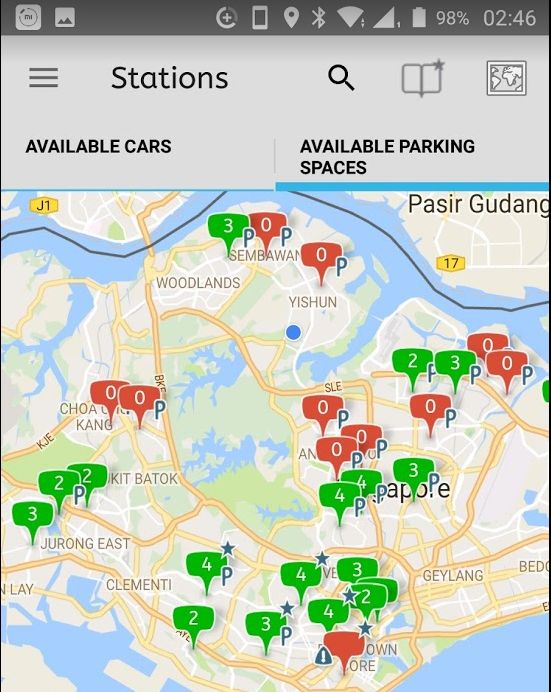
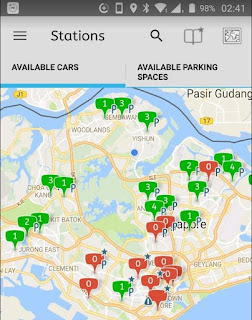
It is interesting to note that it is nearly impossible to book BlueSG near the city after dark (and vice versa).  Apparently, many, living far from city, drive the cars back to home.

Only 1 car to book near city at 3am

  Therefore, during office hours on weekdays, it may be challenging to get a BlueSG car from Woodlands, Punggol or Jurong as all the cars are in the city areas.

There are parking issues at few locations after dark.

The other booking issue is the accessibility of BlueSG cars as most of the locations are not situated near MRTs or LRTs.  They are well hidden inside HDB car parks and it may take 15 minutes to locate the charging station as the locations of BlueSG are somehow misleading (for example: Blk 73 Redhill Road is marked at Blk 74 Redhill road).

The location of Blk 73 is wrongly indicated.
The correct location is indicated by the RED CROSS CIRCLE.

Due to the geographical limitation and the number of parking spaces, it will be foolish to just book and ignore the parking consideration.  You may reserve a car easily but when you intend to return the car, you find that there is no space in the vicinity of 10km radius.  By parking at a distance, you may need to take a taxi back and it defeats the purpose of renting a car altogether.

USAGE CHARGES

At first glance, BlueSG is more expensive than any other car share services offered since it is charged by the minutes.  If you are driving for more than 1 hour, it is better to select car share over BlueSG to save costs.  Car share services also offered special promotions (business hours on weekday or owl special) which are superior over BlueSG plan which is charged by minutes.

DURATION

BlueSG offers shorter duration as compared to Carshare. Since BlueSG charges by the minute, it is increasingly expensive to keep using their service as they do not offer promotions like Owl special or Business Promo in weekdays.  Their focus and strength lies in below 1 hour of driving from Point A to Point B. This begs the question why should user choose BlueSG over Taxi, Grab or Uber?

CONCLUSION

BlueSG may not have the absolute advantages over other Car Share services, it must offer competitive pricing to attract users to stay with the service.  In the end, the winners will be the consumers who have another choice when the MRT breaks down again.

Sunday, 29 October 2017

The myths of China mobile phones

The popularity of China Smartphones

iPhone 8 and Samsung are taking a beating in China as China Smartphones are gaining a strong foothold in the China market. Many of these manufacturers are adopting Android as the OS for their smartphone with heavy investment into making smartphone more responsive, nice looking and most importantly, bringing values to the market.

Huawei is defining the 5G smartphones, Vivo is focusing on selfie, Xiaomi is packaging as a system provider, Oppo is capturing the hearts of overseas marketing with its fluid experiences, Gionee is positioning to capture the hearts of the businessmen and Meizu is penetrating the value segment.  Other companies like Lenovo, Coolpad, 360, ZTE are also fighting to gain a footage in the competitive market.  Smaller companies are also struggling to survive rolling out phones with features such as weatherproof, bezeless, high battery capacity, 6GB or 8GB ram and dual camera.

In the midst of the competition, there are "traps" for consumers to fall into for a bitter experience.

Myth 1: More memory = Better performance

In the early days, iPhone is known to be lag free as compared to Android.  This is no longer true when Android OS is revamped and improved with 80% of smartphones sold in the market.

The simplest way to sell smartphone is to tout of its high memory as it is a well known fact that more memory (ram) is equivalent to less lag, therefore better performance. Premium smartphones are now sold with 6GB or 8GB ram built in to remove the doubts that there is no memory to run applications.

Ask yourself this: We know that the more rice we eat, the more energy we get.  How many bowls of rice produce more energy: 4 bowls or 40?  Definitely, the answer is 40 bowls.  But can our body digest 40 bowls of rice in one shot?  The diminishing marginal rate of return as our body is saturated after gaining enough energy.  Similarly, the phones cannot utilise the extra memory when there are limited apps.  To make matter worst, the apps cannot fully utilise the bandwidth of the memory thus making it run inefficiently.

So how many is enough? The magic number is 4GB when 6GB costs a bomb now. 

High benchmark does not mean better performance

Antutu is one of the popular benchmarking software and a high benchmark score implies the smartphone is better.  Manufacturers tend to place a premium price tag for high benchmark to justify the high performance.  The truth is high benchmark is achieved at the expense of power consumption and producing more heat.

Real life experience is more important than benchmark

Many are fooled by the promise of fastest cpu and ignore real life experiences.  Some premium phones with more memory and storage can run slower than those with less memory and storage due to different operation system and environment.  For example, Huawei's EUI is much fluid than many China OS who are not optimised.

More cores does not mean better performance

MTK 10 core processor has a fantastic benchmark but when executing instructions on single core, the other 9 processors cannot assist to expedite the process.

So what is the purpose of high benchmark and fastest cpu when most of the applications cannot fully utilize all the cores of the processor.  The processor can also run inefficiently with much heat thereby draining the battery life.

Bigger battery does not mean more standby time

Many China's smaller companies produced many phones with big battery capacity like 4,000 to 10,000 mAh.  However, raw battery life does not guarantee a good battery life.  In some cases, inferior batteries are used with poor setting which resulted in sudden drop of battery life from 30% to instant shutdown.  Effectively, the battery of a 4,000mAh is only operating at 70% or 2,800mAh.  This is disappointing as the promise of a high capacity battery is a fallacy.

Dual camera does not mean better quality. Fake camera

Do you know some dual-camera are fake?  You can try out by taking a picture with or without the second back len by blocking one of the lens completely.  Both photos produce identical image! Be mindful when you are promised with a dual camera in your next purchase.

Higher resolution camera does not mean better pictures

The pursuit of higher resolutions is common in those who are ignorant of the technicalities of a good smartphone camera.  Sensor and focal are more critical when considering a good camera.  High resolutions only produce big photo file size which consume more of the your limited storage space in your phone.

Full screen is not really full screen

The latest craze is the bezel-less phone which promises full screen effect.  Just like the fad and hype of 2.5D screen which not only serves as a beautiful vase but has no tangible feature in real life.  A true full screen has many compromises which tests greatly on the designer on antenna and circuit routing and bypasses.  You can only choose 2 out of the following 3 options - real full screen, good signal/GPS strength and good price.

Conclusions

There are many cracks in the selection of good China smartphones which has no standard by itself.  Some manufacturers even has spywares pre-installed to collect the surfing profile and information of the end-users.  The only consolation is consumers are getting smarter and by collective intelligence, inferior manufacturers will be eliminated by boycotting their new products.  We believe tomorrow will always be better than today.

Saturday, 28 October 2017

How to choose your postpaid Singtel Combo Plan?

Singtel Postpaid Combo Plan

Singtel Postpaid Combo Plan is the traditional and standard plan in every telco with a catchy 24 months plan to lock in customers. It is the prime and main plan offered by Singtel to attract customers since day 1 so it should be the first thing potential customers will see. Over the years, it is the cash cow of Singtel so it should offer the best plans to fight against competition. So are you getting the best deal if you are currently in this plan?

What is the current Combo Plan?


Ref: https://www.singtelshop.com/shop/plans-add-ons.jsf#/tab-combo

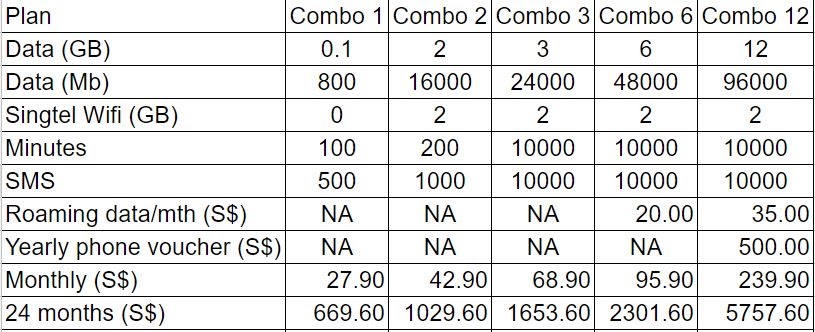
This table is wordy and appears confusing. A better table can be found below.


From the table, it is obvious that the last 3 plans are for those who wanted unlimited minutes and sms.  Combo 12 plan is designed for frequent travellers who wanted to change phone every year (IMO, a silly act to choose flagship phones).  Combo 6 is targeting those who are simply frequent travellers while Combo 3 are those who are not frequent travellers.

So where is the catch? or should I say the "trap"?

First Trap: Buying flagship phones with the most expensive plan

I consider it silly to buy flagship products as discussed in my previous blog.  There are thousands of phones in the market and by sticking to the latest model of a specific company, you are restricting your choice to only 1 model.  This is an ideal scenario of paying diamonds to buy water in a dessert. Singtel capitalised on your hunger and setup the perfect trap to lock you up for 24 months with a heavy penalty if you break the bond. 

Combo 6 and Combo 12 are the perfect trap with free throw-ins such as roaming vouchers (which you may never use) and high value vouchers (S$500) for your next model to trap you for another 24 months.  It is a nice trick to let you voluntarily fall into the same trap every 2 years.

Second Trap: Never consider add-ons

Many customers select their plans based on their monthly consuming minutes, sms and data.  This strategy works in the past but it no longer valid now due to the increasing use of data and the declining use of sms.  With social apps like whatsapp, wechat and skype, we have options to choose data calls instead of conventional calls thereby reducing the needs for calling minutes and sms.  One can dramatically choose a better plan than just based his/her choice on minutes and sms now.

Singtel offers add-on plans (Data X 2, Data X 3 and Data X Infinity) to boost more or unlimited data plan for higher end plans.  With this add-on, it is a game changer after stripping off the gimmicks such as S$20 or S$35 roaming charges and the S$500 yearly voucher.


Net 24 is the total costs of the plan (with or without add-on) after deducting the full roaming charges and the S$500 yearly voucher.  Now, let's discover the "traps".

Plans to consider:
  • Unlimited Minutes Plan - Combo 3
  • Unlimited SMS Plan - Combo 3
  • Unlimited Data Plan - Combo 3 + Data X Infinity

Plans to avoid:
  • Combo 6 (Choose Combo 3 + Data X2 instead)
  • Combo 6 + Data X Infinity
  • Combo 12
  • Combo 12 + Data X2
  • Combo 12 + Data X3
  • Combo 12 + Data X Infinity

Third Trap: Stick to combo plan for data plan

If you are a high data user, Combo 3 + Data X Infinity is the Singtel plan for you.  But you have neglected the trend of more and more people signing up SIM-ONLY plan because they already have a working mobile phone and do not need a new one.

This exposed the weakness of the lower segment of COMBO plan as they are totally unattractive as compared to the SIM-ONLY plan as shown in table below.


Clearly, there are 8 plans better than Combo 1.  Even the cheapest SimOnly (5G + 12 mths) cost lower than Combo 1 and offer 50 more calling minutes, 2.9GB more data and unlimited Singtel Wifi.  The S$100+ difference is the subsidy for a new mobile phone. Why should you pay S$100 for a limited selection of 10 instead of buying from the market of thousands?

Similarly, Combo 2 is also a joke when you compare with SimOnly plan.  If you are interested to have more comparison of Sim-Only vs Combo plan, leave a comment below on what is your range of monthly budget and I will forward the range to your valid email address. Note: Your budget range difference should not exceed S$50 (example: from S$40 to S$90).

Conclusion

Is Combo plan obsoleted in the data dominant era?  If you ask me, it is a definite YES.  Postpaid plan is only good for people with no mobile phone.  Are you one of them?

Friday, 27 October 2017

Top 10 reasons why you should not buy flagship phone in Singapore

Why chasing after flagship phones?

Many are chasing the latest iPhone X or Pixel 2 XL which will be launching soon in end 2017. The local telcos are also rushing to come out with phone plans using the old models to lock their loyal customers for another 1-2 years. Little do the customers know that this old business model is silly and no longer apply to this new world of technology.

Reason 1: Warranty of Phone is only 12 months but contract is 24 months

The warranty of most of the phones are 12 months but the contract is 24 months.  This implies that the high-end phone has no warranty on the 13th month onwards.  Most of the electronic parts seldom break down in the first 12 months and that's why manufacturer are committed to service their phone within the first 12 months.  Why should you sign a 24-month contract to buy a 12-month warranty phone?

Reason 2: Premium phone is sold at a premium during launch

All phones are sold at the highest point to capture the trend setters who buy the story of the manufacturer. After 3-6 months, discounts will be available for the phone and prices will gradually decrease over time.  Why should you buy the phone at the highest point? To support the manufacturer and show off to your friends?

Reason 3: There is no room for discount for a low monthly plan

If you are paying below S$45/month for your phone bill, there is no benefit of getting a high-end phone. The maximum subsidy you enjoy is only S$200 but you must fork out over S$1000 up front. The lowest tier does not enjoy any benefits and are always the last group of customers that the telco serviced.

Reason 4: Use up monthly data in less than 2 seconds!

For high-end phone, they are capable of delivery bullet speed data.  Pixel 2 XL is a CAT 11 4G LTE beast capable of transferring 500Mbps across Singapore.  Given 100MB of data per month under Singtel COMBO 1 plan, you can use up your monthly allocated data in 1.6 seconds. Even if you are having the COMBO 12 plan (S$239.90/month), you only take up 192 seconds or 3.2 minutes to consume your 12GB monthly quota. This sucks!

Reason 5: Features you seldom use

New phones come with many features like NFC, 4k video recording, Face ID, iBeacon micro location, 2.5D, iWatch app and many others which you seldom use. Why pay so much more for something you use once in a while?

Reason 6: Small battery size

The irony of small form factor (<3000mah 2="" a="" about="" after="" and="" bank="" battery="" big="" bigger="" buy="" continue="" day="" div="" for="" forget="" get="" half="" has="" hours.="" hrs="" in="" is="" just="" last="" nbsp="" need="" not="" of="" or="" order="" phone="" power="" recharge="" remaining="" sell="" small="" sufficient="" the="" to="" when="" which="" why="" work="" working="" you="" your="">

Reason 7: High repair costs

Many of the new phones have double sided glass for premium aesthetic look and feel. They are easily contaminated with fingerprints and once it is cracked, the costs of repair can cost up to S$500 since you need to replace glasses on both sides of the phone.

Reason 8: Electronic parts have lifetime

Smartphones are electronic products which are made up with active and passive components. Active and passive products have a lifetime and once their lifetime is up, they will no longer function as required. The design of the phone is also important in determining its product lifetime.  It is a miracle for these designs to last more than 10 years. So it is unwise to buy a high end phone.

Reason 9: Battery cannot last more than 5 years

Most batteries depreciate after extensive use and the lifetime of battery cannot last more than 5 years.  If the design of the battery compartment is small with no allowance for expansion due to heat or pressure, explosion incidents may happen similar to Samsung Note 7.

Reason 10: The next flagship product will be launched tomorrow

There is no end in chasing flagship product.  The moment you buy the current flagship, it will depreciate 10% to 20% on the same day and the next flagship product will be launched tomorrow. Remember: Technology travels fast.

Wednesday, 29 June 2016

Features of a BAD smartphone

List of smartphones to avoid

Chanced upon a few articles that warned that these phones should be avoided. The models and the respective reasons are:

  1. Huawei P9: Leica certified lens but not made by Leica and premium priced
  2. Oppo R9: Simple look and feel
  3. iPhone SE: "Yellow screen" symptoms
  4. LG G5: Premium priced
  5. HTC A9: Mid end chipset selling at premium price
  6. Meizu Pro 6: No new features when compared to Pro 5
  7. Samsung S7: Price keeps dropping every week
  8. Sony Z5: Premium priced
Let's explore further hoping to determine the real reasons behind those bad comments.

Features and Capabilities

Let's review the various specifications of the phones.


Brand ModelLaunch DateChipsetWeight (g)RAM (GB)Storage (GB)Battery (mAh)RMBRetail Price (US$)
Huawei P9Apr-2016Kirin 95514433230003188480
Oppo R9Mar-2016MT675514546428502799422
iPhone SEMar-2016APL089811321616423088465
LG G5Feb-2016MSM899615943228004186630
HTC One A9Sep-2015MSM8974AB16021626001888285
Meizu Pro 6Apr-2016MT6797T16043225602500377
Samsung S7Feb-2016Exynos 8 Octa 899015243230004950745
Sony Xperia Z5Sep-2015MSM899415433229004500678

Even if we provide colours to the table, it is hard to compare. Let's rank them instead.

Brand Model\RankWeight (g)RAM (GB)Storage (GB)Battery (mAh)RMBRetail Price (US$)PointsRank
Huawei P9733744282
Oppo R9658566361
iPhone SE811155216
LG G5353433216
HTC One A9111388224
Meizu Pro 6153277253
Samsung S7553711224
Sony Xperia Z5433622208

Purely based on these specifications, Oppo R9 comes out top as the best phone while Sony Xperia Z5 is intending to rip customers off.

You may argue that some features are more important than the rest such as the battery capacity. If you give 5 times the points to features which you value the most.  In this instance, let's give x5, x3 and x2 to Price, Battery and Storage respectively.

Brand Model\RankWeight (g)RAM (GB)Storage (GB)Battery (mAh)RMBRetail Price (US$)PointsRank
Huawei P973621420612
Oppo R9651615430761
iPhone SE8123425438
LG G535612415456
HTC One A91129440573
Meizu Pro 61566435573
Samsung S75562145465
Sony Xperia Z543618410456

With different values in the eyes of different consumers, your choice of a phone becomes clear.  Oppo R9 is still the best and iPhone SE is the worst phone to get.

Conclusions

Although Oppo R9 is listed as the phone to avoid, it still can be an option when you are getting a new phone. After all, it becomes a benchmark to avoid.

If you have other ways to compare different phones, share and give your comments too.


Featured Post

BlueSG vs CarShare

BlueSG vs CarShare Since 12 Dec 2017, the first electric car rental has started business in Singapore and there is no need to pay for petr...