Friday, 12 February 2016

Get FREE 2GB Google Drive in 30 seconds

Free 2GB Google Drive

Christmas was gone but Google is giving away free 2GB now to mark Safer Internet Day 2016 starting from 11 Feb 2016 and ending on 17 Feb 2016.  The whole process only takes 30 seconds of your time if your security setting is up to speed.

How to get 2GB?

Follow the following steps:
  1. Visit Google: https://security.google.com/settings/security/secureaccount
  2. Login
  3. Check your security information. Take your time to beef up the internet security of your google account.  Get free 2FA if possible.
  4. Upon completion, you will get 2GB FREE immediately.
If you are not sure, comment below so we can help you.

How much is 2GB?  You have 15GB for free and 2GB will be a good bonus to keep all your data and files and google drive.

Enjoy the 2GB!

Thursday, 4 February 2016

Test Your Brain

Why brain test?

Human always pride themselves as smart and intelligent creatures because we are equipped with a brain to think, analyse and make decisions.

Unfortunately, life's monotonous routine has killed our creativity and you may need a strong injection to stimulate your thinking and creativity process.  Hopefully this simple test of 30 questions can bring back the zest in your life.

Be warned! This test ventures beyond the boundary of IQ.  Every individual has only one try.  Treasure it.


Wednesday, 3 February 2016

The Future of Smartphones

Current Technologies

We have seen the emergence of iPhone in 2007 till the current smartphones we have in our wallet.  These mobile devices have transformed our lifestyle and habits and it is hard to imagine how we can communicate without them.

Some predicted smartphones will be gone in 5 years from now as Internet of Things (IoTs) are replacing how things are talking to each other smartly.  Who will chart the future of smartphones?  Before these visions become reality, what are the things you wish to have in the immediate tomorrow?

Immediate Promises

  1. Charging Issues
    During the era of Nokia, this single company itself cannot make a consistent charging port.  Apple shows the same sign when it introduced an upgraded charging port for iPhone 6. Android has embraced USB3.1 Type C as the next standard to phrase out the older USB 2.0 charging port.  Physical contact promises fast or quick charge which is badly needed by heavy duty smartphones as more and consistent current is delivered.  Contactless charging is emerging but acceptance is slow due to the long charge duration.
  2. Longer Battery Life
    Many have come out innovative ideas of how to make battery last longer.  One Oppo phone cheated by placing two batteries inside a phone and claimed "5 minutes charging to talk for 2 hours".  The constraint is a special charger which can only use for this phone.  On a daily basis, applications are main causes for battery draining and the battery itself are purposely made small so it is presented light to the user.  If you uninstall Facebook App, study has found that you can extend battery life by 20%.  If you like your Facebook so much, you should look into higher capacity battery (6000 mAh and above) instead of fanciful features (curve?) of your next smartphone.  Unfortunately, battery technology is stagnant unless we can move beyond Li-on or Li-Polymer without any adverse dangers of explosion and heat.
  3. Contactless Payment
    Near Field Communication, HotKnox and Bluetooth are the common transfer techniques used.  They demonstrated the ease of data exchange with reasonable speed.  However, moving forward to financial payment are dragged down by the security concerns.  In fact, having these features on will make stealing of data possible.
  4. Fingerprint Recognition
    It is the defacto requirements for 2016 as we are anticipating the loss of our phones via theft or robbery.  Protection of personal data and information become an essential instead of a desired feature.  Swiping and password are too simple means to lock the phone and using biological identity makes unlocking harder.  Premium of S$100 is required from users who are dying for such protection.
  5. Ear Piece
    Frankly, connecting a ear piece makes the phone less smart.  With wireless bluetooth, ear piece should be obsoleted long ago.  It will make the phone more resistant to water and weather by hiding the 3.5" audio port.

Future Promises

  1. Display Technology
    After you have your 5.5" screen, it is hard to imagine going back to your 3.5".  For the current generation of users, they will have serious health issues with their neck, eyes and fingers due to overtaxing their joints for long hours.  Display technology can improve how we see and use the device ergonomically.  Prototype of projection and paper thin displays are available pending the reduction of mass production costs.  But the essence lies in the time spent in using the phone instead of how we use it.  It is the duration that kill.
  2. Connecting to IoTs
    IoT is no longer a futuristic term as many are having smart homes as the ultimate goals. We are using bracelets, rings and watches to monitor our health and movement.  Governments are integrating essential services with IoTs to bring forward the concept of smarter nation.  Beside of challenge of good software, the challenge is to lower the cost of IoTs so that it can be incorporated into daily accessories and devices with wireless security in check.  In fact, some predicted that IoTs will completely replace smartphone as the communication elements in smartphone can be integrated with IoTs to provide a hands-free experience.

The Essential

It is nice to have the latest technologies for future proof.  At the same time, you have to know what do you need most.  More often than not, consumers are blindly following the masses and bought phones which have tons of feature with a limited battery capacity (Remember iPhone 5?).  Will you pay for a $800 wireless charging phone (5 hours charging time) over a budget $200 basic phone (2 hours charging time)?  "Never!", you shouted.  The next day, you fall into the same trap when your friends are all carrying the same flagship product.


Friday, 29 January 2016

Best Postpaid Plan in Singapore (Without Contract)

Best Postpaid Plan in Singapore (Without Contract)

The Era of No-Contract Mobile Postpaid Plan

The initial sunk cost (or investment) of setting up telecom infrastructure is high.  In the early days, to promote mass market of mobile phone, telecom operators adopted free phone for a 2-year contract.  In today's context, the strategy of giving free phone is no longer practiced.  Instead, telecom operators twisted to "subsidise" the phone for your 2-year contract.  If you are silly enough to sign up for a free phone, then you are one of those good customers who are "stupid" to pay more for an inferior phone (or $0 phone) at a premium price.

You may challenge: What inferior phone?  My answer is simply you are paying extra (minimum $10/month) for 24 months.  Telecom company has collected $240 over 2 years for the lowest plan.  They have successfully lock you in for 24 months else you will be penalised for breaking the contract.  As long as manufacturers are willing to sell the mobile phone for less than $200, they can sell the phone at cost but their objective to tie you down for 2 years is achieved.  To make higher margins, some phones cost only $50 so they can make high margin if you select an outdated smartphone.  Well, with such high margin, they can afford to throw you some free gifts to sweeten the deal.

If you have a high-end or reasonably solid smartphone, it can last you for 4 to 5 years and there is no need to change a new one after 2 years.  Why should you be paying for another 2 years contract and the penalty of $240?  So telecom companies will give you voucher as high as $500 because you have already paid them $1000 in the last 2 years.  By sacrificing some profits, they are able to secure and lock you in for another 2 years. More good years!

When M1 started offering postpaid plan without contract, others follow reluctantly as many abandoned the postpaid contract after maturity.  It is a wise thing to do because you can choose what you need.  For example, if you only wish to call out, just pay $36.05 for unlimited minutes instead of over $200.  Imagine how much you can save or how much telecom company was earning!  The best part is you have the freedom to jump ship anytime since there is no contract to bind you for 24 months.  Besides choosing a phone which you like that can last for more than 2 years, you must decide which plan is suitable for you?

Look no further, just participate in the survey below and we will send you the best plan to suit your lifestyle with the minimum cost.  Do not trap yourself with the current mindset of 2 years contract and get a new phone.  You should free yourself from the standard S$36 for a 100-min/mth plan and look beyond the free phone and contract.  Communication should be bond free to be enjoyable.

Wednesday, 27 January 2016

What SIM card for Malaysia for Singaporeans?

The prepaid SIM cards

I used U Mobile, Maxis, Celcom and Digi SIM cards and most expired due to failing to top up within the stipulated time thus confiscating the remaining amount of money prepaid.  This is a minus for owning a sim card without long life. Now, I only have Digi and Celcom SIM cards which serve me well.

The article I wrote 5 years ago (12 Nov 2009) was no longer valid as many have changed since.  Many points mentioned have their merits as they are the basic needs for Singaporeans in a foreign country.  Since then, the emergence of Mobile Virtual Network Operators (MVNOs) offers a spectrum of options to fulfill the needs of individuals at an attractive rate.  Our lifestyle has also changed dramatically when we are more addicted to smartphone.  Wifi and data have become our basic needs defying Maslow's theory.

Factors to consider

I list down some concerns for Singaporeans who are visiting Malaysia:

1. Calling minutes vs Online Data

There are 3 types of SIM card: Calling, Data or Both. Many are blindly buying any sim card for calling but who are you calling in a foreign land with few friends? Even if you have many relatives and friends, are you going to talk for hours instead of meeting them in persons?  If not, why are you going into Malaysia?  For some, they are conned into buying data-only SIM card and not realising that it cannot make any outgoing calls.
2. Speed of Mobile Network

Malaysia is different from Singapore.  It is still developing its 4G network and some companies only has 2G or 3G to offer.  The price can be cheap but the speed is worst than a 56k modem. Make your peace if you want to save a few penny and lose a dollar.  Some may throttle your speed after the maximum is exceeded.

151201-speedtest-fastest-mobile-network-malaysia

Surprisingly, U Mobile is named the fastest mobile network in Nov 2015 by Ookla.

3. Network coverage

Without network, you cannot make any call or receive any data similar to a phone without battery.  For mobile network, 4G/LTE is vital for your network speed.  Bearing in mind that no telcom can cover 60% of the entire Malaysia (2015 Q3), you can get good network only in cities and towns.  This is deadly for MVNOs who are riding on to the Big 4 for bandwidth. 

We see that in the entire Malaysia, Maxis has the widest 4G coverage in Malaysia (~60%) while U Mobile has only (37%).  Celcom has the fastest 4G download speed (~15Mbps) while Digi has less than 10 Mbps.

4. Reliability of network
This is an important consideration but many ignore this important criteria.  The technologies also play a decisive role.  Let me illustrate below.


For Johor Bahru 4G network, Digi stands out as the best while Celcom is the worst.


For KL, Celcom wins with the strongest coverage in 4G while Maxis has the weakest coverage.


For Penang, Celcom wins by a narrow margin while U Mobile has zero 4G presence at all.  But you can expect U Mobile to provide 3G internet speed which can be up to 20 times slower than 4G.


If you go to Tioman, you can throw away your Digi, Maxis or U Mobile SIM because only Celcom has reasonably good 3G network.  Sorry, 4G must wait... longer.

In a nutshell, you cannot trust anyone who share his or her experiences with you because the destinations maybe different.  Malaysia has East and West portions and the coverage strengths vary for different telcos.  Specially for JB (Jan 2016), Digi has the strongest 4G coverage so it should be your default choice for SIM card for data speed.

For West Malaysia, Celcom is still the leader in reliability and network coverage.

5. Expiry date of SIM card

Normally, a SIM card will expire if you never top up after 6 months. So, it is not advisable to top up too much into it if you seldom visit Malaysia often.  For every top up, there is also an expiry date depending on the period you choose.  For instance, if you top up RM 10 for 7 days, the SIM card will be deactivated (cannot call and sms but you can receive call) after 7 days unless you top up again.  Therefore, even after you buy the SIM card, you must also choose wisely to select what type of plan is suitable for the period you are in Malaysia.  Read more on how to choose the best Digi data plan for prepaid.
6. Recharge Value

Many are attracted to a SIM card because they only need RM 1 for top up.  But you cannot expect to pay peanut for an elephant. Generally, the top up rates differ slightly so it should not be a concern here because I trust the market forces are at work.
7. Availability of recharge vouchers
If you cannot find any shops selling recharge voucher, you will waste precious time hunting for a voucher and this will disrupt your journey and plans.  Personally, I have a hard time finding Celcom vouchers in JB.  I understand from the shop owners that there is no demand for Celcom vouchers as most Johorians are using Digi.  Why?  You can find the answer on the 4G network coverage picture above.

8. MVNOs
They are the second-layer players piggy bag on the Big 4.  They offer attractive rate but fail to deliver on coverage and reliability.  They are as reliable as what their principals can provide.


From OpenSignal.com, Digi is obviously doing something right while Maxis is doing poorly in most areas.  A closer inspection reveals that Digi may have too many sign-up customers using 4G that saturates the download speed.  Celcom, on the other hand, has good reliability and download speed of 4G network.  This is a plus point for Celcom and its MVNOs.

Making Decision

Just focusing on Johor and JB, I list down the table for Big 4 focusing on 4G data, coverage, reliability, download and upload speed.


Digi has weakest signal in Johor but its reliability is the best.  The 4G network for Johor and JB are similar and Maxis is superior in all fields against U Mobile.  If you can live with U Mobile's spec together with a value for money offer, you can consider U Mobile and its MVNOs.  Else, we are left with only the BIG 3.

Between Celcom and Maxis, Maxis is a better choice as upload speed is a secondary concern and it is tough to buy Celcom's reload voucher in JB.  Thus, the final battle is between Maxis and Digi.

Since Digi always has a lower price tag for online data, it is the obvious choice and we shall bear with its slower download speed and its weaker signal.

You can consider Digi's MVNOs below but none can beat Digi on the voucher purchase:
  1. Happy Mobile (nothing to be happy about with website down);
  2. Tron (with 365 days of validity); and
  3. Speakout (3G network with free incoming calls).
Things change and the above are valid for now and with TM joining the 4G race this year and RedOne offering RM8/mth postpaid service, the winners in this fierce competition will definitely be YOU.

What are you waiting for? Go JB and grab a Digi SIM Card now and read this BEFORE you step foot inside JB.

Tuesday, 26 January 2016

Which Digi Mobile Plan (Prepaid SIM) to choose?

Going to Malaysia

There is a growing number of Singaporeans who travel to Malaysia to shop and eat due to the attractive exchange rate of S$1 to RM3.12 (highest).  I have received many requests to update my best prepaid phone card for Singaporean and unfortunately, my other commitments deterred me from doing so.  I promise that I will update the blog soon.

Digi Prepaid SIM Data Plans

I am still having my loyal Digi Prepaid SIM.  Why Digi?  It is the most popular telco in Johor Bahru and the vouchers are available everywhere.  Although the network coverage is the worst among the 3 main telcos, it is the preferred choice for many Johorians due to its value for money plans.  Digi offers bonus plans if you select certain plans.  For selective plans, it offers unlimited Whatsapp and WeChat or some MB for Facebook for as low as RM 1, which none of the other telcos can match.  If you are keen in choosing one prepaid SIM card, choose the SMART prepaid and NOT the BEST prepaid for data.  An additional perk is you enjoy free unlimited calls and SMS to 3 buddyz and free basic internet and social app!

Unethical Business Model?

Normally, I am using HERE to navigate the streets.  But it does not help to avoid road works and accidents resulting in jams.  The online purchase of data plan is a nightmare and there are various ways to choose a plan such as *116, *126, *128 etc.  The presentation is messy, overlapping and confusing.  If you cannot win over the customers, confuse them?

To make matter worst, Digi fails to tell you that if you fail to unsubscribe the plan before you leave Malaysia, it will auto deduct the plan when you top up next time.  Well done!  It is okay to make good money but unethical to make it this way.  For a few times, I have topped up RM10 and instantly deducted RM5 for a plan I failed to unsubscribe last time.  Hello, Digi, where is your ethic?

Order in Chaos

I am fed up with this situation as I have no way to access the internet while on the road to read over the fine prints, I need to know what plan do I need before I enter Malaysia BUT I have no time to research.  Where can I find a website with such info?

I took some trouble and wrote a guide on what data plan should I be buying.  If you are a Digi prepaid customer, feel free to try out and tell me if it is working for you.  Inside this guide, I have omitted the overlapping plans which are repeated to confuse customers and highlight which plans you should avoid signing up.  The best part is you will be shown the DIRECT USSD CODE to send and select the plan to cater for your choice.  Remember to complete the guide and submit to find the most useful tip for UNLIMITED WEB SURFING even when you have run out of data.

Run through the guide and write down the code before you venture into Malaysia again.

Saturday, 13 December 2014

The best FREE GPS navigation app for Android in Singapore

The demise of GPS devices

With the popularity of GPS app in mobile phones, standalone GPS devices are slowly fading away giving in to the integrated GPS app.  Hardware wise, high end mobile phone are much more powerful than conventional GPS devices with enough storage and computing strength.  The only question is what app to consider.

Who needs GPS navigation?

Some may argue that Singapore roads are straightforward and well routed rendering GPS navigation unnecessary.  They fail to factor in new ERP gantries set up in new locations, the ever changing traffic conditions, new speed cameras trap, new red light detection cameras and road diversion or closure due to events or construction.

Unless you are travelling short distance to and fro work from home, you may need a good mobile GPS app to save you time and money on the road.  Anyway, most of these apps are free.

If you are just interested to get the location details of a specific area, GPS app will also come in handy to provide what are the amenities available in the area. 

Competition of GPS Apps

There are many GPS apps around the world but many are restricted and optimised for regional use.  In Singapore, the most popular are listed below:
  1. Waze, Free
  2. Here (Nokia), Free
  3. Maps (Google), Free
  4. Galactio SG, Free
  5. Maps.me, Free
  6. NAVFone GPS SG (AGIS), S$6.99
  7. Papago! GPS, S$37.43
We shall evaluate the first 5 apps as the remaining are paid apps.

WAZE

Developed by Israeli startup, Waze is acquired by Google in 2013 and it taps on the social strength for real-time traffic update.  With many users around the world, real-time traffic are gathered and captured and later used to assist users to determine the best route to their destinations.

When mobile data is present, users can actively update traffic status to the server and share with other users.  When mobile data is absent, map update and re-routing are not possible.

HERE

Formerly known as Ovi Maps and Nokia Maps, HERE has covered nearly 200 countries and just exit beta testing phrase in Android platform.  One of the strength of HERE is they have existing Places of Interests (POIs) which are valuable for searches and locating purposes.  Even when mobile data is not available, offline access and navigation are possible.

GOOGLE MAPS

Maps is a de facto app in all Android phone well integrated in the Operating System (OS).  The navigation capability is great but marred by the local expertise and the update frequency.  Generally, it is a best 2nd alternative if you have no primary GPS app.  Another drawback of Google Maps is the compulsory requirement of mobile data else it is an useless app.

Galactio SG

In Nov 2010, Land Transport Authority (LTA) Singapore released the location table and Quantum inventions include traffic incidents information, traffic speeds, parking availability, weather, road closures etc inside this app.  The presumption is you must have mobile data plan to enjoy such updates before and during the drive.  With data plan, there are 5 modes of transport whereby you can choose either the shortest, fastest, toll avoidance, toll minimised or traffic aware mode.

Maps.me

This is a great offline map tool created in Moscow, Russia.  The map origins from OpenStreetMap and the app provides navigation without voice.  Bookmarks are easily created and navigation can be provided completely without data plan.  GPS is afterall free for use.  Worldwide maps can be downloaded for free and the details are realistically practical for use.  If you are touring a country, it is a must have app to put in your phone.

Which app is for you?

Based on the comparison table, we come out with the following recommendation:

  1. Waze: This is the best app for social traffic update and sharing of your location if you have data plan.
  2. HERE: For those without mobile data plan, this is a must-have app if you are driving overseas.
  3. Google Maps: This is the backup app we propose.
  4. Galactio SG: This is our winner for daily use in Singapore provided you have mobile data plan and a smartphone with 1GB ram.  You are able to avoid all toll and EPR charges while driving.
  5. Maps.me: This is the best app if you are travel overseas.  Download it before you leave town.  It will be handy even if you are not driving.
Leave your comments if you have some doubts.  Travel safe.

Saturday, 15 November 2014

In-Depth: How to select your dream smartphone within your budget?

Guide of selection your dream smartphone

Participate in the guide at the end of this page and find out what you really need.  Read on...

===

Are Reviews and Recommendations Good?

There are many reviews on how to select a smartphone in various websites and we wonder yself if there is a need to write this post.  Some are keen on getting the latest iPhone 6 plus because it is the latest hip thing to get.  Some are unwilling to pay extra for a better smartphone and let the customer service representative decide for them for a free phone. Many of them have little knowledge of the smartphones they are buying and willing to try something new.  The customer representative at the counter will likely to introduce some smartphone which they have the most stocks or can give them the most commissions.  Because the customers have no clue of what deals they are getting.  All are zero cost smartphones with different brand names.

These customers do not research.  Even if they research for a smartphone, more often than not, these websites are only promoting the latest phones to attract eyeballs and provide limited models of phones which are sold in the region or country.  With the emergence of XiaoMi as the 3rd largest player in the world market, USA and Europe seldom include XiaoMi or other China phones in their reviews due to standard compatibility and phone availability.

On the other hand, blame not the reviews as customers are blindly following the mainstream.  The recent saga in Sim Lim Square of a Vietnamese factory operator willing to spend 4.5 times his monthly salaries to buy a iPhone 6 for his girlfriend proved that people are willing to pay.  We have seen clueless customers being persuaded to get Nokia phones when they sign up for 2 years contract based on counter recommendation on durability.  When complications arise, the losers are always the customers.  So, we hope this guide can provide an unbiased and fair evaluation of your needs and more importantly, within your budget and means.

Hold your horses, cowboy! We shall not insist that you should buy our ideal smartphone simply because your needs are different from ours.  We simply show you the direction of where you should  go.

Be Honest With Yourself

Let's begin with some basic questions and make sure you pen them down for reference later...
  1. Do you really need a smartphone? Why? Write your needs down.
  2. What is your budget for a smartphone?
  3. Do you have an Operating System (OS) in mind?
  4. Do you care about the aesthetic of the smartphone? 
  5. Do you have a manufacturer or brand in mind?
These questions primarily dictate what your smartphone should be.  For instance in Question (5), if you have already decided to get iOS, you can only choose from Apple phones.  Instead of getting the latest iPhone, you can based on your budget and consider a second hand phone such as iPhone 4S or iPhone 5S which are significantly cheaper than iPhone 6.  No one can stop you from selling both your kidneys to buy iPhone 6 and iPhone 7 but you may have no kidney to sell for iPhone 8 which may launched in 5 years' time.

Know Your Current Plan

Ask yourself:
  1. Are you currently on prepaid or postpaid plan?
  2. Do you have a bundle program with your carrier (or telco)?
If you are on a bundle postpaid plan, you are likely to enjoy some discounts for all your products and services.  It is better to stick to your current plan so you can continue to enjoy such discounts unless there is better offer from other carrier.

The X Factors

There are many features in the next generation smartphone.  For each feature, there is a price premium to pay because they are unique selling points to every manufacturers.  How about selecting 5 top features which you badly wanted and compare against those phones in the market.  If they met all the top 5 criteria, your next smartphone is confirmed.  Else, you may have to look at the open market or overseas for your dream phone.

Guide of selection your dream smartphone

Participate in the guide below and know more about what you really need in your next smartphone.  Good luck and have fun!


Monday, 27 October 2014

The era of diesel cars is here...

TO BUY or NOT to BUY?

Humans have depleted black oil in an exponential rate faster than it can produce naturally.  Some predicted that there will not be any black oil after another 100 years.  With no gas for cars, other forms of energy are needed to power up our transport vehicles.

Electric cars are the main stream of replacement and there are many effort put in place for innovations.  If you visit LTA website, you will notice that Hybrid (aka Petrol-Electric) cars are gaining market share in Singapore.  But the cost of owning a hybrid car has little incentive but the cost is exorbitant.  It is nearly a prestige to own one.  Can the savings offset the premium of hybrid car?

If you dig further, you notice that Peugeot 2008 1.6 e-HDI EGC active car running on diesel has a mileage of 3.8 L/100km (Combined).  This is way better than an old car running at 9.0 L/100km.  With the pending retirement of 30% of the car population in Singapore due to expiry of 10-year COE, it is a good time to consider all options: To buy or not to buy?

OPTION 1: BUY NEW CAR

If you want to buy, you may wish to get the best deal.  Here, we will review only the petrol costs of ownership in the next 10 years.

Petrol or diesel is expected to increase over the years and on average, we predict that the price may increase by 50% in the next 10 years.  This is a logical presumption based on the petrol price in 2004 is S$1.50/litre and now 2014 is US$2.20/litre.

The choice is whether to get one running on petrol or diesel.  The next question to ask is whether to get a hybrid or not.

OPTION 2: EXTEND COE

You may also opt to extend the COE of the current car if it is still in mint condition.  However, in view of the high COE, it is not a great option now.

GAS COSTS FOR 10 YEARS

The estimated gas consumption for 10 years are:
  1. Old car (1.6 litre extend COE 10 years): S$32,116.50
  2. New car (1.6 litre petrol): S$24,979.50 (Saving: 22.22%)
  3. New car (1.6 litre diesel): S$11,970.70 (Saving: 62.73%)
  4. New car (hybrid on petrol): S$ 13,560.30 (Saving: 57.78%)
  5. New car (hybrid on diesel): S$ 11,094.80 (Saving: 65.45%)
  6. Electric car:: S$5,897.80 (Saving: 81.64%)
Interestingly, if you choose diesel cars, the saving on gas is more than 50%.  If you choose hybrid on diesel, you will pay S$11k instead of S$33k.  Really? Why? What is the trick?

There is no tricks.  Just make sure you choose an efficient car that RUNS ON DIESEL.  Why?  Because you will save S$20k in the next 10 years.

If you can afford, get a hybrid car running diesel.  Peugeot 2008 (S$117k) is one of these diesel cars.  In LTA website, only 3 out of top 40 gas saving cars run on petrol.

For electric option, the new 2015 Volkswagen e-Golf and Fiat 500e consumed only 2.02 litre/100km (US Environmental Protection Agency aka EPA).  In short, you will pay only less than S$6k instead of S$32k over 10 years factoring inflation on gas prices.  A hidden cost is the battery depreciation which warrants a change every 3 to 5 years (same for hybrid cars).  The biggest headache is there is no way to charge your car battery in Singapore...yet.

OTHER WAYS TO SAVE COSTS

There are also other costs involved which you may wish to read further HERE.  You may choose to take a cab instead of buying.

Alternatively, you can change your driving behaviour and learn from Wayne, who clocked 59 MPG or 4 litre/100km on an old Accord.

Friday, 10 October 2014

The economy of taking taxi

Introduction

Taxi is hailed as the most expensive personal transport for those who do not own a car.  It is deemed impossible to book during peak and shift changing hours and costs a bomb for long distance travel.  In this tiny island, there are 6 taxi operators fighting for the slices of market share with demand always outstripping supply.

Mobile Apps

With the emergence of taxi apps such as GrabTaxi, EasyTaxi and Uber, there is simply no turning back now.

Conventional booking methods adopted by taxi companies are outdated and could not cope with the demand of the customers.  I have personally waited 30 minutes on my mobile and still there is no taxi available as informed by the operator.  Perhaps, the operator is the bottleneck as well as a cost factor.

Mobile app connects the customer to the taxi driver directly and eliminates the middleman.

Supply of taxi

More importantly, mobile apps also do not restrict customer to a particular taxi company and broaden the choices of the customer. In particular, private cars under Uber can respond and indirectly UberX forms the 6th "taxi company".  To consumers, more is always good as choices are available to meet demand.

From another perspective, taxi drivers can wait for bookings instead of circling round and round to hunt for prospectives thereby saving petrol.  It is a win-win situation.

Consumer Experiences

The satisfaction from customers is the ultimate measure of whether the services are good.  By having more choice, direct messaging and contacting with the driver, real time tracking of approaching taxi, cashless payment and the ability to give ratings on the drivers complete the entire service evaluation. By the conventional method of calling for cab, it is always a one-way traffic and there is hardly any feedback loop unless you lost something or the driver is nasty.

Cheaper taxi fares?

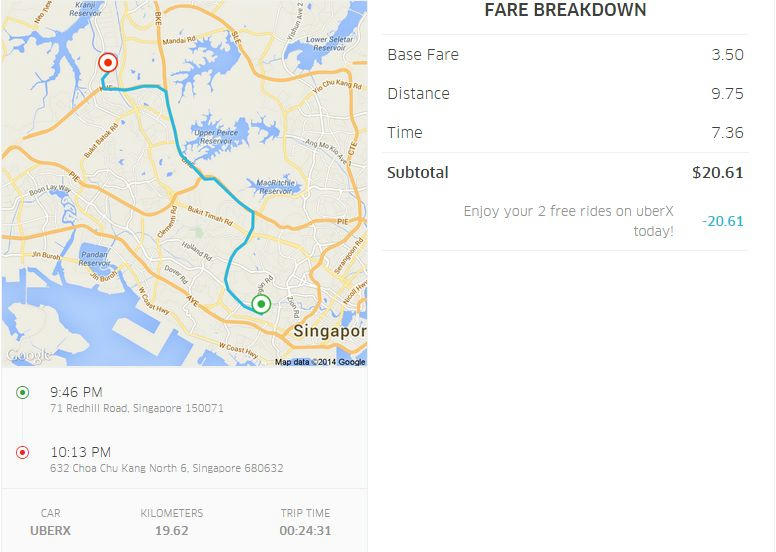
Uber claimed that there is a 25% savings if you book UberTaxi.  We managed to get an actual case of UberTaxi during off peak period clocking a distance of 23.91km and a trip time of 24:55min.  The charged fare is S$20.62 which is 19.1% cheaper than normal cab rate (S$24.58).


Another saving can be the booking of premium cab for short distance of less than 12km.  The standard rate is S$38 for less than 4km or S$50 for other distance.  Using UberExec, a short distance of 6km costs only S$22.10.  This is especially useful during peak hours and normal cabs are hard to come by.

Extra goodies

GrabTaxi offers GrabCar (6) and GrabCar (13) which can accommodate more than 4 passengers.  This is particularly handy when we wish to move in group and booking of multiple taxis is a co-ordination nightmare.

EasyTaxi has the lowest booking fees of only $2 during off peak period and like all 2 mobile apps, provide cashless or credit card billing services.

Uber has an ongoing promotion which gives $10 for one-timer.  Enter promotion code uberdear can instantly give you $10 to try out their service.

Conclusions

It is exciting to look forward and guess what these companies are offering.   We have yet to try out MoobiTaxi, Split it, Come Fetch Me, Taxi Monger and Taxi Booking.  They are new comers and are looking for their pie of the cake in the taxi industry.  To consumers, it is always good news that more mobile apps are available to offer choices for us.  Perhaps, the best is yet to come.

Tuesday, 7 October 2014

Cheapest drive to Johor from Singapore

From 1 Oct 2014, the toll charges in Causeway have increased and it is no longer economical to drive to Johor Bahru town centre.  The traffic is still crowded during peak hours but one thing is certain: no one with a sound mind will drive in just to pump petrol or take a meal especially he is alone.  Having said that, it is still worthwhile if the car has 4 or 5 passengers to share the costs.

Straits Times reported that there is a saving of 30% incentive (S$9.40) to use the second link (http://www.straitstimes.com/news/singapore/transport/story/second-link-traffic-likely-increase-higher-causeway-tolls-kick-201409).  However, the maths just simply does not add up.  Perhaps it is a misunderstanding on their part or they listen to the wrong advice.

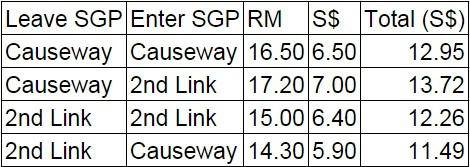
One may wonder which option is the cheapest to drive to Johor now with second link thrown in.   Below chart can be your reference:


From the table, you will save S$1.50 by driving to Johor via Second Link and return via Causeway.  By factoring the petrol costs and possible toll charges between the 2 destinations, the net saving may vanish altogether.

The Malaysian authority has accurately priced the toll charges in Causeway in anticipation of Singapore's move to equal its tolls.  In general, it costs S$11.50 to 13.70 to make a round trip.

Featured Post

BlueSG vs CarShare

BlueSG vs CarShare Since 12 Dec 2017, the first electric car rental has started business in Singapore and there is no need to pay for petr...